





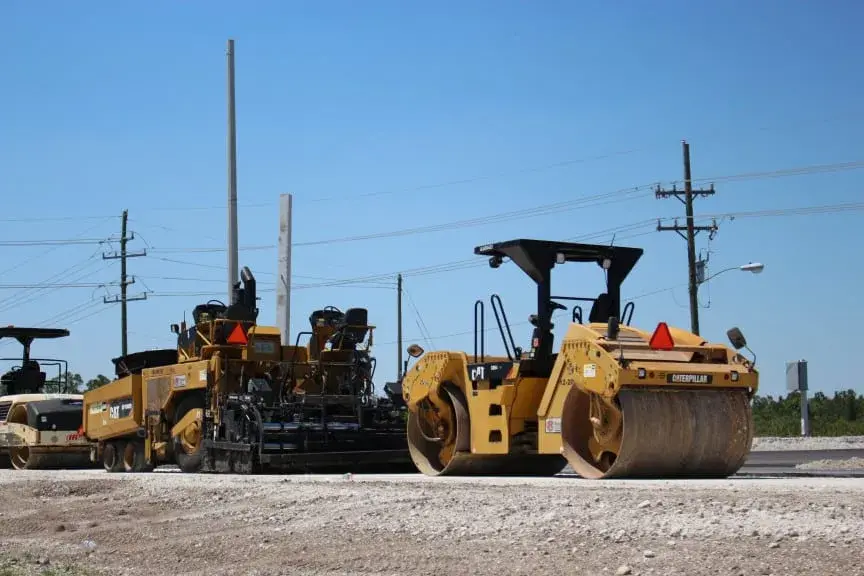
Heavy equipment shipping is one of the most specialized segments of the freight transport industry, and it's one we see more of every year at American Auto Shipping. Whether you're a construction company moving an excavator to a new job site, a farm relocating a combine harvester, or a rental company distributing equipment across multiple locations, the logistics of moving machinery that weighs 10,000 to 80,000+ pounds requires planning, expertise, and the right equipment. This guide covers everything you need to know about shipping heavy equipment in 2026.
The range of heavy equipment that ships across the country every day is enormous. Construction equipment -- excavators, bulldozers, backhoes, skid steers, wheel loaders, and cranes -- represents the largest segment. Farm and agricultural equipment -- tractors, combines, planters, balers, and tillage equipment -- is a close second, with seasonal spikes during planting and harvest. Industrial equipment includes forklifts, generators, compressors, and manufacturing machinery. Each type has its own weight, dimensions, and transport considerations. A compact skid steer at 6,000 lbs is a straightforward flatbed load. A D9 bulldozer at 50,000 lbs with a 15-foot blade width? That's a full-scale heavy haul operation.
The trailer you use depends entirely on the equipment's size, weight, and dimensions. Standard flatbed trailers handle equipment up to about 48,000 lbs, with a deck height of roughly 60 inches. They work well for compact equipment, small tractors, forklifts, and machinery that clears standard height limits. Step-deck (also called drop-deck) trailers have a lower rear section that provides extra height clearance -- useful for taller equipment that would exceed the 13.5-foot legal height limit on a standard flatbed. Lowboy trailers (also called low-bed or double-drop) sit much lower to the ground, with a deck height of 18-24 inches. These are the workhorses of heavy equipment transport -- they handle the biggest, heaviest, tallest machinery. An RGN (Removable Gooseneck) trailer is a type of lowboy where the front detaches and creates a ramp, allowing equipment to drive directly onto the trailer under its own power. This eliminates the need for a crane to load.
Permit requirements for heavy equipment are often more extensive than for oversized vehicles. Federal bridge law limits truck-plus-cargo weight to 80,000 lbs on Interstate highways. Any load exceeding that requires overweight permits. Width limits of 8.5 feet and height limits of 13.5 feet apply as well -- and a lot of heavy equipment exceeds one or both. A standard excavator with the boom laid flat might sit at 10 feet wide and 11 feet tall on a lowboy -- within limits. But a large bulldozer with a 14-foot blade could be 12 feet wide, requiring wide-load permits and possibly escort vehicles. Superloads -- equipment over 16 feet wide, 16 feet tall, or 200,000+ lbs -- require extensive route surveys, bridge inspections, utility line clearance checks, and sometimes road closures. These add significant time and cost.
What does heavy equipment shipping cost? Costs are driven by five main factors: weight, dimensions, distance, permit requirements, and whether the equipment is operable (can drive onto the trailer) or inoperable (needs a crane or winch). Here are general ranges for 2026. Compact equipment (skid steers, mini excavators, small forklifts) under 15,000 lbs: $500-$1,500 for regional moves, $1,500-$3,500 for cross-country. Mid-size equipment (standard excavators, backhoes, farm tractors) 15,000-40,000 lbs: $1,500-$4,000 regionally, $3,000-$7,000 cross-country. Large equipment (bulldozers, large excavators, combines) 40,000-80,000 lbs: $3,000-$8,000 regionally, $6,000-$15,000+ cross-country. Superloads over 80,000 lbs: pricing is fully custom and can run $15,000-$50,000+ depending on the specific equipment, route, and permit requirements.
Preparing heavy equipment for shipping is critical for safety and cost control. Secure all loose attachments -- buckets, blades, forks, and booms should be locked in travel position. Retract hydraulic cylinders and secure articulating joints. Remove or fold mirrors, antennas, exhaust stacks, and any components that extend beyond the machine's base dimensions -- every inch of extra width or height can trigger additional permit requirements and costs. Drain all fluids if required by the carrier (some carriers require partial fluid drainage for weight management). Disconnect or tape over battery terminals to prevent accidental starts during transport. Clean the equipment enough to inspect for existing damage and document its condition with photographs.
Documentation matters more in heavy equipment shipping than almost any other transport category. Before the equipment is loaded, photograph it from every angle. Document serial numbers, hour meter readings, and the condition of key components (tracks, tires, hydraulic hoses, glass, paint). Note any existing damage -- dents, cracks, fluid leaks, broken glass. This documentation is your baseline for any damage claims. The Bill of Lading should include detailed descriptions of the equipment, its dimensions, weight, and noted condition. Both you and the driver should sign it. At delivery, perform the same inspection and compare to your pre-shipping documentation.
Timing and scheduling are important factors that many shippers overlook. Heavy equipment carriers are specialized -- there aren't as many of them as standard auto transport carriers, and they often book 1-3 weeks in advance for standard moves. Urgent or expedited heavy hauls can be arranged but cost 30-50% more. Seasonal demand affects availability: construction equipment demand peaks in spring and summer when building season is in full swing. Farm equipment demand spikes during planting season (spring) and harvest season (fall). Planning ahead and booking with adequate lead time gives you the best pricing and carrier selection.
Insurance for heavy equipment transport is structured similarly to other freight, but the dollar amounts are larger. Carriers must carry liability insurance, and most carry cargo insurance. However, the value of heavy equipment -- a new CAT 336 excavator retails for over $400,000 -- often exceeds standard cargo insurance limits. Verify the carrier's per-unit and per-occurrence cargo insurance limits before shipping. For high-value equipment, arrange supplemental cargo insurance. We verify insurance for every company we work with and flag coverage limits so you can make informed decisions.
American Auto Shipping has become a go-to name for heavy equipment shipping because we put your shipment in front of verified heavy haul companies with the specialized trailers, permits, and experience this segment demands. When you request a heavy equipment shipment through us, the partners that respond have the right trailer type for your equipment, active permits for your route, verified insurance covering your equipment's value, and documented experience with your equipment category. Get your free heavy equipment shipping estimate -- provide your equipment details and compare offers from qualified heavy haul companies.
Key Takeaways
- •How much does it cost to ship heavy equipment?
- •What type of trailer is used for heavy equipment?
- •Do I need permits to ship heavy equipment?
Frequently Asked Questions
Heavy equipment shipping costs depend on weight, dimensions, distance, and permits. Compact equipment under 15,000 lbs runs $500-$3,500. Mid-size equipment (15,000-40,000 lbs) costs $1,500-$7,000. Large equipment (40,000-80,000 lbs) runs $3,000-$15,000+. Superloads over 80,000 lbs require custom pricing.
The three main trailer types are flatbed (for equipment under 48,000 lbs and standard dimensions), step-deck (for taller equipment needing extra height clearance), and lowboy/RGN (for the heaviest and tallest machinery). RGN trailers have a removable gooseneck that creates a ramp for self-loading.
If the loaded truck exceeds 80,000 lbs total weight, 8.5 feet wide, or 13.5 feet tall, you need permits. Most mid-size and large equipment triggers at least one of these thresholds. Permit costs run $50-$200 per state, and some loads require escort vehicles at $1.50-$2.50 per mile.
Related Resources
Ready to Ship Your Vehicle?
Get your free estimate in 60 seconds. American Auto Shipping has helped customers ship over 235,000+ vehicles since 1999.
Get a Free QuoteRelated Articles
Helicopter Shipping Services and What to Know About Them
Helicopter shipping services aren't all that common, probably because helicopters are meant to be flown. But they definitely exist and they're a good thing to use if your helicopter doesn't fly. And even if it does, sometimes it's better to ship it than to fly it to its destination. It's like a car ...
How We Estimate Car Shipping Costs Now, and Why Every Number Shows Its Math
Every price range on this site now comes from one published formula: a fixed charge, tiered mileage, this week's diesel price, the season, and your vehicle. Here is the formula, the current numbers, and what an estimate can and cannot tell you.
Shipping a Car to Hawaii: What It Costs, Which Port, and How Long It Really Takes
Hawaii is not a long domestic move with a boat at the end. It is an ocean shipment with its own rules -- an agricultural inspection, an operable-vehicle requirement, and a port schedule that does not care about your moving date. Here is how it actually works.
The EV Weight Penalty: Why Shipping an Electric Car Costs More in 2026
Quotes for electric vehicles keep coming back higher than the gas version of the same car, and customers assume it is a surcharge for special handling. It is not. It is a federal weight limit written in the 1970s meeting a battery pack built in 2026 -- and it costs the carrier slots on the trailer.
More Guides
How to Ship a Car: The Complete 2026 Guide
A step-by-step walkthrough of the entire car shipping process, from getting your first quote to taking delivery. Everything you need to know to ship a vehicle in 2026.
Car Shipping Costs: Everything You Need to Know in 2026
A detailed breakdown of car shipping pricing by distance, vehicle type, transport method, and season. Learn what actually drives costs and how to avoid bait-and-switch quotes.
Open vs Enclosed Auto Transport: Which Is Right for You?
A head-to-head comparison of open and enclosed auto transport with pros, cons, pricing differences, and practical advice on when to use each method.
How Long Does It Take to Ship a Car?
Transit times by distance, factors that affect timing, pickup windows, and expedited options. Realistic timelines based on 27 years of shipping data.