





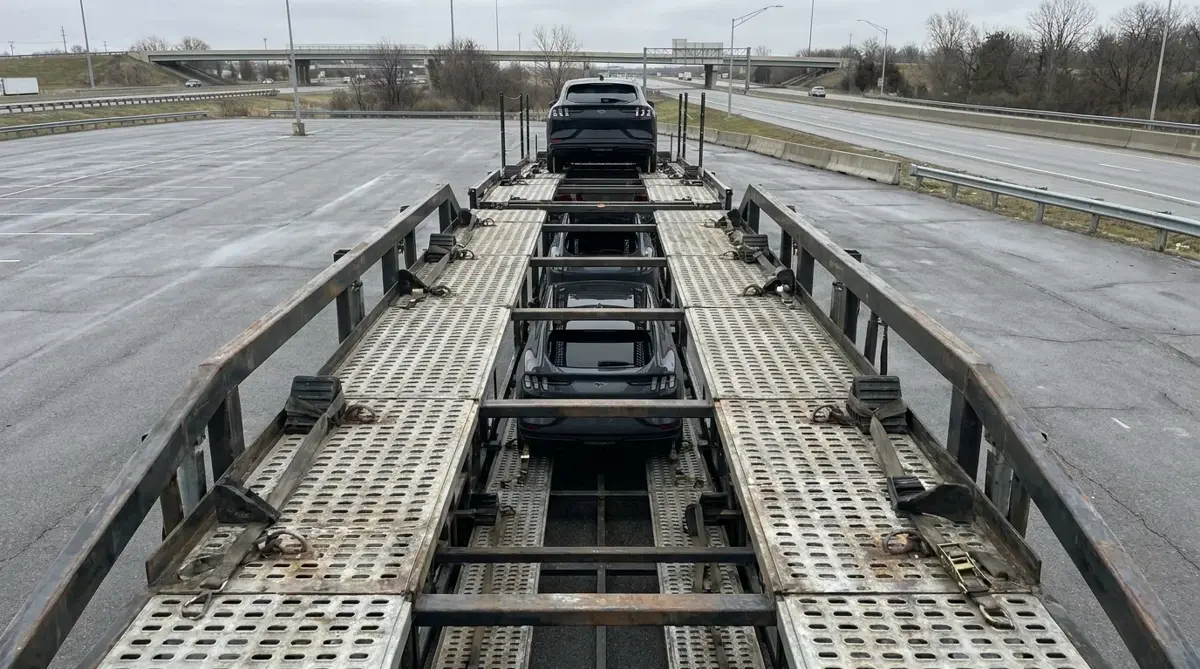
★ Key Takeaways
- ✓Federal law has capped trucks at 80,000 lbs since the 1970s, and that ceiling -- not the space on the trailer -- is what limits how many cars a hauler can carry.
- ✓A dual-motor crossover EV runs roughly 4,500 to 5,500 lbs against about 3,500 for a comparable gas crossover. Nine of those puts a truck over the limit before the trailer is full.
- ✓Carriers respond by running slots empty. A trailer that holds nine sedans may only take six or seven EVs, and the revenue for that trip gets spread across fewer vehicles.
- ✓That is the entire reason an EV quote comes in higher. You are not paying for special handling -- you are paying for the empty slots your battery displaced.
- ✓A bill in Congress would let auto haulers carry an extra four tons per trip. Until something like that passes, expect the EV premium to stick around.
We get some version of this call every week now. Somebody is moving a Model Y and a RAV4 across the country, same route, same dates, and the quote for the Model Y comes back higher. The assumption is always that we are charging extra to handle an electric vehicle -- something about the battery, or insurance, or special equipment. It is none of that. The real answer is a federal weight limit from the 1970s running headfirst into a car built in 2026, and once you see it you cannot unsee it in your quotes.
Federal law caps a truck on the interstate at 80,000 lbs, total, and has for about fifty years. That number covers the tractor, the trailer, and everything on it. A car hauler's tractor and empty trailer eat up a big chunk of it before a single vehicle is loaded. What is left is the cargo budget, and here is the part people miss: a hauler runs out of that budget long before it runs out of physical space on the deck. The slots are not the constraint. The pounds are.
| Electric vehicle | Approx. curb weight | Comparable gas model | Approx. curb weight |
|---|---|---|---|
| Tesla Model 3 | ~3,900 lbs | Toyota Camry | ~3,300 lbs |
| Tesla Model Y | ~4,400 lbs | Toyota RAV4 | ~3,500 lbs |
| Hyundai Ioniq 5 | ~4,200 lbs | Hyundai Tucson | ~3,400 lbs |
| Ford F-150 Lightning | ~6,500 lbs | Ford F-150 (gas) | ~4,700 lbs |
| Rivian R1T | ~7,100 lbs | Toyota Tacoma | ~4,400 lbs |
Do the arithmetic with real cars and it gets obvious fast. Load nine gas sedans averaging about 3,500 lbs and you are carrying roughly 31,500 lbs of vehicles -- comfortably inside the budget. Now load nine dual-motor EV crossovers at 4,500 to 5,500 lbs each and you are somewhere around 45,000 lbs. That truck is over. So the driver does the only thing available: leaves slots empty. A trailer that would have carried nine cars goes out with six or seven.
“You are not paying extra because your car is electric. You are paying for the two empty slots your battery pack pushed off the trailer.”
That empty space is what you are actually paying for. The truck burns the same diesel to Chicago whether it is carrying nine cars or six. The driver gets paid the same. The insurance, the tolls, the maintenance -- all identical. The only thing that changed is how many customers are splitting the bill. Spread a trip's cost across six vehicles instead of nine and every one of those six costs more. That is the EV premium, and it has nothing to do with your car being harder to load.
Ready to ship? Get a real price in 60 seconds.
We put your shipment in front of licensed auto transport companies running your route this week, and they send you their best offers — no obligation, no spam.
Get My Free Quote →The trucks themselves are not helping the math either. Look at the table above -- the gap is not subtle. An F-150 Lightning weighs about a third more than the gas F-150 it is based on. A Rivian R1T is closer to three and a half tons. These are not exotic outliers anymore; they are ordinary vehicles sitting in ordinary driveways, and every one of them displaces more than its share of a trailer. Meanwhile American vehicles in general keep getting bigger, so even the gas side of the ledger is creeping up.
There is a fix in the works, at least potentially. The trucking and auto industries have been pushing a bill in Congress that would let auto haulers run about four tons over the current cap, on the reasoning that the 80,000 lb number was written for a fleet that no longer exists. If it passes, a good chunk of this premium goes away, because those empty slots come back. Until then, this is simply the cost structure, and any company quoting you an EV move is working inside it whether they explain it or not.
A few practical things do help. Flexible pickup dates matter more for an EV than a gas car, because the carrier is solving a heavier puzzle and needs the right mix of vehicles to fill a trailer legally. Being honest about the exact model up front matters too -- a quote built on the wrong curb weight is a quote that gets revised later, and nobody enjoys that conversation. And if you are shipping two vehicles, mentioning both at once often helps, since a carrier balancing a heavy EV with a lighter sedan can make the tonnage work.
We put your vehicle in front of vetted, licensed carriers who compete for it, which for an EV means finding the ones whose trailers actually have the tonnage to spare rather than the ones guessing. Get your free estimate or call us at (800) 930-7417.
About the Author
Written by the American Auto Shipping team, in auto shipping since 1999. Prices and transit times in our posts are estimates from our published method; the real price comes from the company you book with.
Learn More About Auto Shipping
Shipping To or From These Areas?
Auto transport by city