





★ Key Takeaways
- ✓College car shipping typically runs $600--$1,500 depending on distance -- the most common corridors (Northeast to Southeast, California to anywhere) average $800--$1,200 for open transport.
- ✓Book by mid-July at the latest: August is peak season for college shipments, and carriers that service university towns fill up 3--4 weeks in advance.
- ✓Large car haulers (75--80 feet) cannot navigate most campus roads -- plan for a commercial lot or off-campus meeting point within 1--2 miles of the dorms.
- ✓Students (not just parents) should understand the Bill of Lading: inspect the vehicle at pickup and delivery, note any damage, and keep a signed copy.
- ✓Open transport is the right choice for 95%+ of college cars -- the 50--60% enclosed premium isn't worth it for a daily-driver sedan or SUV headed to a campus parking lot.
If you've got a kid heading to college this fall -- or heading back for another year -- and they need their car on campus, right now is the time to start planning. Not August. Not the week before move-in. Now. We've been helping families ship vehicles since 1999 and every single August we watch the same thing happen: families call us in a panic because move-in day is a week away and they haven't booked transport yet. The carriers that service university towns are already full, prices have spiked, and everyone is stressed about a problem that was completely avoidable with three weeks of lead time. This guide covers everything you need to know about shipping a car to college in 2026 -- costs, timing, campus logistics, paperwork, and the mistakes that trip up first-timers every year.
Let's start with costs because that's what everyone wants to know first. College car shipping runs anywhere from $600 to $1,500 depending on distance, and the most common corridors average $800 to $1,200 for standard open transport. A student shipping from New Jersey to the University of Alabama -- about 950 miles -- is looking at $700 to $1,000. California to University of Texas -- roughly 1,400 miles -- runs $900 to $1,200. Shorter runs like New York to University of Michigan at 600 miles come in around $550 to $800. These are real ranges from the offers our customers receive, not generic estimates. The variables that push you toward the high or low end are the same as any auto transport shipment: time of year (August is peak), how far in advance you book (earlier is cheaper), and how flexible you are on pickup dates.
| Corridor | Distance | Open transport cost | Transit time |
|---|---|---|---|
| New Jersey → University of Alabama | ~950 mi | $700--$1,000 | 3--5 days |
| California → University of Texas | ~1,400 mi | $900--$1,200 | 4--6 days |
| New York → University of Michigan | ~600 mi | $550--$800 | 2--4 days |
| Illinois → University of Florida | ~1,100 mi | $700--$1,000 | 3--5 days |
| Massachusetts → Georgia Tech | ~1,000 mi | $750--$1,050 | 3--5 days |
| California → University of Washington | ~800 mi | $600--$900 | 3--4 days |
Speaking of timing -- this is the single most important factor in college car shipping and it's the one that catches families off guard every year. August is the busiest month for auto transport in general because of summer relocations, but the college surge makes it even more intense. Think about the scale: there are roughly 20 million college students in the United States. A meaningful percentage of them need vehicles on campus. And nearly all of them need those vehicles delivered within a two-week window around their specific school's move-in date. That concentrated demand spike means carriers servicing routes to college towns fill up fast. If your kid's move-in is August 18th, booking on August 5th is too late for a comfortable timeline. You need to book by mid-July at the absolute latest -- and booking right now in late June gives you the best combination of pricing and carrier availability.
“The biggest mistake we see every August isn't overpaying -- it's families who call on August 10th expecting pickup by August 15th. That ship has sailed, sometimes literally.”
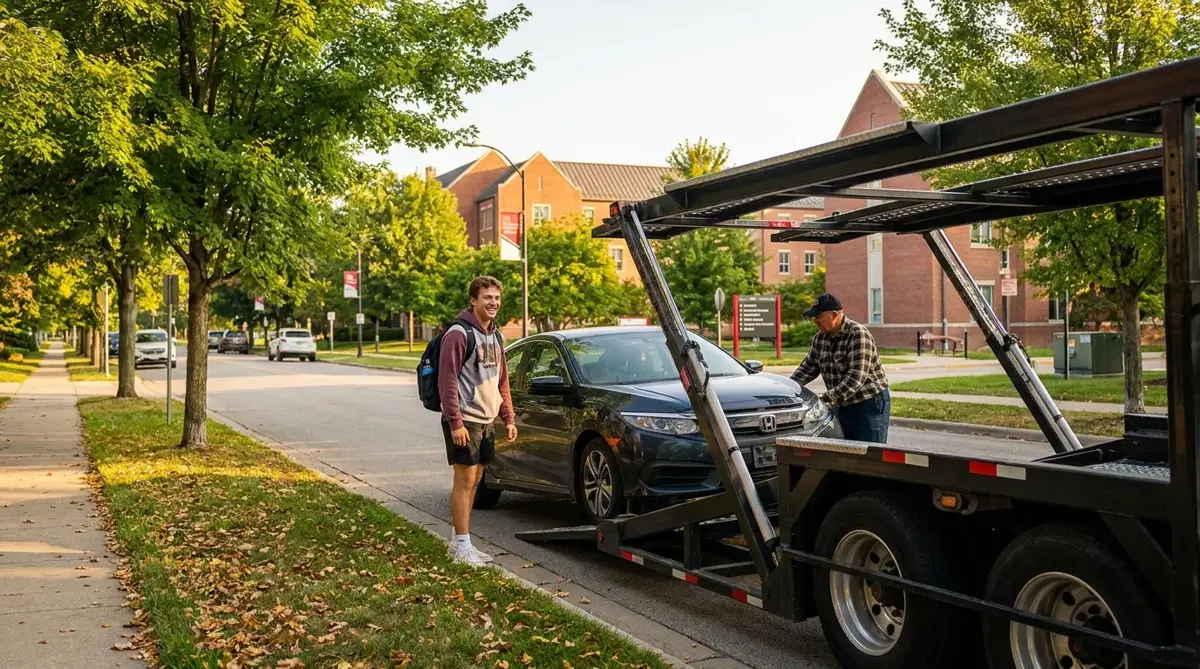
Here's something that surprises a lot of parents: the physical logistics of delivering a car to a college campus are more complicated than delivering to a regular residential address. A standard car hauler is a 75-to-80-foot rig. It cannot navigate narrow campus roads, roundabouts, pedestrian zones, parking garages, or the tight streets around most university housing. Trying to get an 80-foot trailer into a freshman dorm parking lot is simply not going to work. The solution is to arrange a meeting point at a nearby commercial area -- a shopping center parking lot, a big-box store lot, or any open area within a mile or two of campus where the carrier can safely park and unload. Most college towns have obvious options. If your student is at the University of Michigan, the Briarwood Mall lot works perfectly. At University of Florida, there are plenty of commercial areas along Archer Road. At UT Austin, the carriers know the drill -- there are established drop-off points near campus. When you book, tell the company it's a college delivery and agree on an accessible meeting spot with the driver.
Ready to ship? Get a real price in 60 seconds.
We put your shipment in front of licensed auto transport companies running your route this week, and they send you their best offers — no obligation, no spam.
Get My Free Quote →Now let's talk about the paperwork -- specifically the Bill of Lading, or BOL. This is the single most important document in any auto transport shipment, and it's something every student needs to understand, not just the parents. The BOL is filled out at pickup and again at delivery. It documents the vehicle's condition -- every scratch, dent, and ding. At pickup, the driver inspects the car and notes existing damage. The person releasing the vehicle (parent or student) reviews it and signs. At delivery, the person receiving the vehicle (usually the student) does another inspection, compares it to the pickup documentation, and signs. If there's new damage, it needs to be noted on the BOL before signing. Here's the problem we see every August: Mom and Dad ship the car from home, but the student receives it at school. The student has never dealt with a BOL, doesn't know to inspect the vehicle carefully, signs off without looking, and then notices a scratch three days later. At that point, it's much harder to file a claim. Make sure your student knows the drill: walk around the car, check every panel, compare to the photos you took before shipping, and don't sign a clean delivery BOL if there's damage.
Open versus enclosed is a question we get from parents constantly, and the answer for college cars is almost always open. Open transport -- where your vehicle is on an uncovered multi-car hauler -- is perfectly fine for a daily-driver sedan, SUV, or compact car heading to campus. Your kid's Honda Civic or Toyota Corolla does not need enclosed transport. The enclosed premium is 50 to 60 percent more, and that money is better spent on textbooks, a meal plan, or literally anything else. Enclosed makes sense for high-value vehicles -- a $60,000+ luxury car, a classic, or something with sentimental value that justifies the premium. But for 95 percent of college cars, open transport is the smart choice. The vehicle will be exposed to the same weather it would encounter driving on any highway in America. It might need a wash when it arrives. That's it.
Vehicle prep for college shipping is the same as any shipment, but there are a few college-specific things worth mentioning. First, remove everything from the car. We mean everything -- the dorm supplies you thought you'd ship inside the vehicle, the boxes of clothes, the mini-fridge you wedged into the back seat. Carriers are licensed to transport vehicles, not household goods. Personal items aren't covered by carrier insurance, they add weight, and loose items can shift during transit and damage the interior. Ship your dorm stuff separately via UPS, FedEx, or a moving company. Second, leave about a quarter tank of gas. Third, make sure the car starts and drives -- if it doesn't, tell us upfront so the offers come from carriers with the right equipment. Fourth, take photos of every panel, the wheels, the roof, and the interior before the carrier arrives. Text those photos to your student so they have them for the delivery inspection.
A few practical tips that come from 27 years of watching college shipments play out. First, coordinate the delivery timing with your student's move-in schedule. Most schools have specific move-in windows, and some require appointments. Make sure the car arrives during or shortly after the student's move-in window -- not before, when they might not have anywhere to park it, and not three weeks after when they've been stranded on campus without transportation. Second, if your student's campus has parking permit requirements, make sure that's sorted before the car arrives. Nothing worse than having a car delivered and immediately getting it ticketed because the parking pass isn't set up yet. Third, consider whether your student actually needs a car freshman year. Many campuses actively discourage it -- parking is expensive, public transit exists, and the campus is walkable. But if the school is in a suburban or rural area where a car is essential, shipping beats a 15-hour solo drive by an 18-year-old every time.
Let's talk about the drive-versus-ship decision because parents wrestle with this every year. On paper, driving a car 1,000 miles to college seems cheaper -- just gas and maybe a hotel night, right? But add it up honestly. Gas for a 1,000-mile drive is $150 to $200 at current prices. A hotel night is $100 to $150. Food on the road is another $50 to $75. That's $300 to $425 for the outbound trip. Then one parent needs a flight home -- that's $150 to $400 depending on the route. Total: $450 to $825, plus two days of your time, vehicle wear and tear, and the stress of a long drive. Shipping that same car costs $700 to $1,000 -- sometimes less if you book early and offer flexible dates. The price difference shrinks fast when you count the full cost of driving, and shipping is zero stress. The car shows up, you fly in for move-in day, done.
Get ahead of this now. August will be here before you know it and carrier availability on college routes is already starting to tighten. Get your free estimate and compare offers, and you'll see real rates from carriers who are actually running your corridor. We've helped families ship cars to every major university in the country and we put your shipment in front of carriers who know the college-town delivery logistics. Don't be the family calling us on August 10th in a panic. Book now, lock in your rate, and cross one more thing off the move-in checklist.
About the Author
American Auto Shipping
Dave Armstrong is one of American Auto Shipping's longest-tenured team members. As content manager and strategist, most of what you read on this website came from him. He has extensive knowledge of the auto transport industry, having spent time in every role the business has to offer.
Learn More About Auto Shipping
Shipping To or From These Areas?
Auto transport by city