




The short answer
To bring home a car bought from an out-of-state private seller, verify the title is clean and lien-free, get a bill of sale, check the VIN history, and have a local mechanic inspect the car before you pay. Book the transport before you send payment so the car isn't stranded, and use a payment method you can trace, such as verified funds or an escrow service you chose yourself. Someone must be at pickup to hand the keys to the driver and sign the Bill of Lading.
★ Key Takeaways
- ✓Line up your carrier BEFORE you pay, not after -- so the car isn't stranded in a stranger's driveway while you scramble to find a truck.
- ✓Never send full payment until you've verified the title is clean, in the seller's name, and lien-free -- a title problem can strand both your money and the car.
- ✓A $100-$200 pre-purchase inspection by a local mechanic is the cheapest insurance you'll ever buy on a car you've never seen in person.
- ✓Door-to-door open transport takes about 2 to 3 days on a short move and 7 to 11 days coast to coast, plus a pickup window. Current price ranges for your route are in our estimate tables.
- ✓Have the seller or a trusted stand-in at pickup to hand the keys to the driver and sign the bill of lading. The signed title comes to you directly, not on the truck.
We've been in auto transport since 1999, and one type of call has gotten a lot more common in the last few years: someone found the exact car they want -- right year, right mileage, right price -- except it's sitting in a private seller's driveway two or three states away. Buying from a private party out of state can be a genuinely great deal. But it comes with a wrinkle nobody warns you about: the moment you hand over the money, that car is yours, and getting it home is now your problem to solve. Here's how we walk customers through it so the transport part turns out to be the easy part.
Start by remembering you're buying a car you've probably never seen in person, and that changes how careful you need to be. Confirm the VIN on the listing matches the car and the title, run a vehicle history report, and -- this is the step people skip and regret -- pay a local mechanic near the seller $100 to $200 for a pre-purchase inspection. It's the cheapest insurance you'll ever buy. A good inspection catches the frame damage, the leaking head gasket, or the odometer that doesn't add up, none of which show up in photos and a friendly phone call.
| Step | What to do | When |
|---|---|---|
| 1. Verify the car | Confirm the VIN, run a history report, get a local pre-purchase inspection | Before you commit |
| 2. Check the title | Confirm it's clean, in the seller's name, and has no lienholder | Before any payment |
| 3. Book transport | Get competing offers and lock in a pickup window | Before you pay |
| 4. Pay safely | Use escrow or verified funds once title and inspection check out | At agreement |
| 5. Pickup day | Seller (or a stand-in) signs the bill of lading and hands the keys to the driver | Pickup |
| 6. Delivery | Inspect on arrival and note any new damage on the bill of lading | 2-10 days later |
The title is where out-of-state deals quietly fall apart. Before a single dollar changes hands, confirm the seller actually holds a clean title in their own name, with no lienholder listed. If there's still a loan on the car, the lender holds the title, and you're suddenly coordinating a payoff between you, the seller, and a bank -- doable, but it adds steps and time you'll want to plan for. Don't assume; ask for a clear photo of the actual title and read it.
“The moment you send that payment, the car is yours -- including the problem of getting it home. Book the carrier first, not last.”
Here is the paperwork, in the order it matters. First, the title: it should be a clean title in the seller's name with the VIN matching the car. Ask for a photo of the front and back before you commit, and check the VIN against a vehicle history report. The federal National Motor Vehicle Title Information System (NMVTIS) reports title, odometer and certain damage history, and the reports cost a few dollars. Second, a bill of sale: a simple signed page with both names and addresses, the VIN, the odometer reading, the price and the date. Many states want one to register the car, and it protects both sides. Third, a lien release if the seller ever had a loan on the car. A lien stays on the record until the lender releases it, even after the loan is paid off, so ask for the lender's release letter or a title that shows the lien cleared. Do this before you pay, not after.
Ready to ship? Get a real price in 60 seconds.
We put your shipment in front of licensed auto transport companies running your route this week, and they send you their best offers — no obligation, no spam.
Get My Free Quote →Registration happens in your state, not the seller's. Plan to bring the signed title, the bill of sale and proof of insurance to your DMV. Rules vary by state, and some ask for a VIN verification or an emissions test, so look at your state DMV's page for out-of-state purchases while the car is still on the road. Don't assume you can drive it legally on the seller's plates once you own it, and don't assume the car needs to be registered before it ships; the carrier moves it as freight.
Payment safety deserves its own paragraph, because this is where buyers lose real money. Be wary of any deal that insists on a wire transfer, gift cards or a reloadable card, since those are close to impossible to reverse. If you use an escrow service, pick it yourself rather than accepting one the seller suggests, and go to the service's website by typing the address, not by clicking a link in a message. The advice from consumer protection agencies is consistent: the FTC recommends an independent mechanic inspection before you buy, and state attorneys general warn about fake escrow sites and urgent pressure to pay. If the price looks far below market, treat that as the warning sign it usually is.
Now the part most buyers get backwards: line up your transport before you pay, not after. We can't tell you how many people wire the money, celebrate, and then realize the car is stranded in a stranger's driveway while they frantically call around for a carrier -- with the seller texting them to please come get it. Get your competing offers and lock in a pickup window as part of closing the deal, so the handoff and the transport happen together. Through American Auto Shipping you send the request once and licensed companies make offers, so you can have a truck scheduled before you ever send payment.
When it's time to pay, protect yourself. For a private-party car sight-unseen, an escrow service or verified bank funds beats a wire transfer you can never claw back. Release the money once the title checks out and the inspection comes back clean -- not a moment before. A legitimate seller won't blink at a reasonable, documented payment process, and one who pressures you to just wire it fast is telling you something.
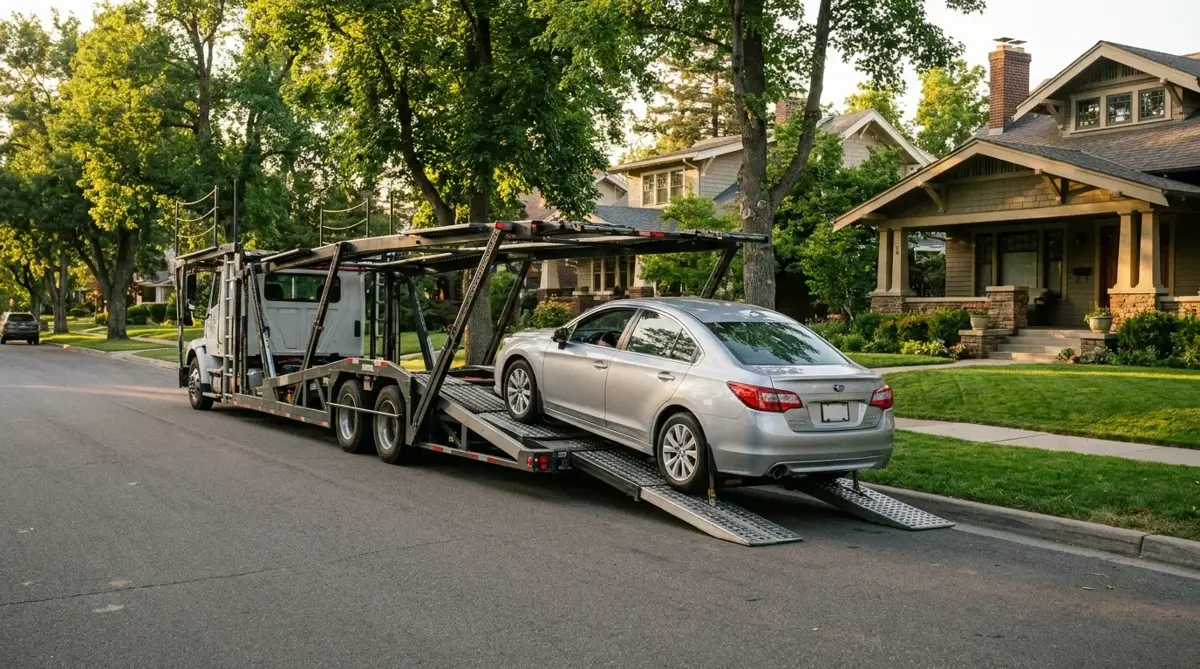
Pickup day is really a coordination problem, and the fix is simple: someone has to be there. The seller, or a trusted stand-in, needs to hand the keys to the driver and sign the bill of lading with them -- the document that records the car's condition at pickup. If the seller travels for work or can't be home, arrange a friend, family member, or neighbor to meet the carrier, and tell the driver who to expect. The signed title is a separate hand-off: it goes to you in person, by tracked mail, or once your payment clears, not on the truck. And take timestamped photos of the car from every angle before it loads; that's your baseline if any question comes up at delivery.
So what does the transport itself cost and take? For a running sedan on open transport -- the standard, most affordable method -- the price depends on road miles, the season and the current diesel price. Our route pages and cost estimator show current ranges from a published formula, so we don't hand you a number from memory. Transit time comes from the same formula: about 2 to 3 days for a few hundred miles, 3 to 5 for 1,000 miles, and 7 to 11 coast to coast, plus a pickup window of 1 to 5 business days. Enclosed transport costs more and makes sense for a collector car or something high-value. Door-to-door simply means the carrier picks up at the seller's address and delivers to yours, with no terminals and no middle leg where the car sits waiting.
This is exactly where competing offers beat calling one company. With American Auto Shipping, vetted, licensed auto transport companies compete for your shipment. You tell us the pickup and the delivery, and carriers who already run that corridor make their offers, which gets you a real market rate instead of one take-it-or-leave-it number. Get your free estimate or call us at (800) 930-7417, and you can have the getting-it-home part lined up before you close the deal -- so buying that out-of-state car is the fun part, not the stressful one.
Frequently asked questions
Do I need the title before the car ships?+
You need to be sure the title is clean, in the seller's name and free of liens before you pay, but the title does not travel with the car. The driver only needs the keys and a signed Bill of Lading. The signed title should reach you in person, by tracked mail, or after your payment clears.
What if the seller still has a loan on the car?+
The lender holds the title until the loan is paid off, so the sale has to include a payoff and a lien release. Ask for the lender's release letter or a title showing the lien cleared before you send the full amount, and expect it to add a few days.
What if the seller can't be there for pickup?+
Have a friend, family member or neighbor meet the driver, hand over the keys and sign the Bill of Lading. Tell the driver who will be there, and have the stand-in take timestamped photos of the car from every side before it loads.
Do I need a bill of sale?+
Yes, get one. It should list both names and addresses, the VIN, the odometer reading, the price and the date. Many states ask for it when you register the car, and it documents what you paid and when.
How should I pay a private seller I have never met?+
Avoid wire transfers, gift cards and reloadable cards. Use verified bank funds or an escrow service that you choose yourself, and release the money only after the title, the lien status and the inspection check out.
How long does shipping a private-party purchase take?+
About 2 to 3 days of transit on a short move, 3 to 5 days for 1,000 miles and 7 to 11 days coast to coast, plus a pickup window of 1 to 5 business days. Booking before you pay lets the pickup window start as soon as the deal closes.
Sources
- Buying a Used Car (private sellers, "as is" sales, independent mechanic inspection) — Federal Trade Commission
- NMVTIS buying tips: get a vehicle history report and an independent inspection — U.S. Department of Justice, Bureau of Justice Assistance
- Online Car Sales: Don't Get Scammed (wire transfers, escrow services, clearing funds) — Minnesota Attorney General
- How to get a lien release — Bankrate
- SAFER Company Snapshot (look up any transport company by USDOT or MC number) — Federal Motor Carrier Safety Administration
- How we estimate: the published formula behind our transit windows and price ranges — American Auto Shipping
- How long does it take to ship a car? — American Auto Shipping
About the Author
American Auto Shipping · Updated by American Auto Shipping
Written by the American Auto Shipping team, in auto shipping since 1999. Prices and transit times in our posts are estimates from our published method; the real price comes from the company you book with.