




The short answer
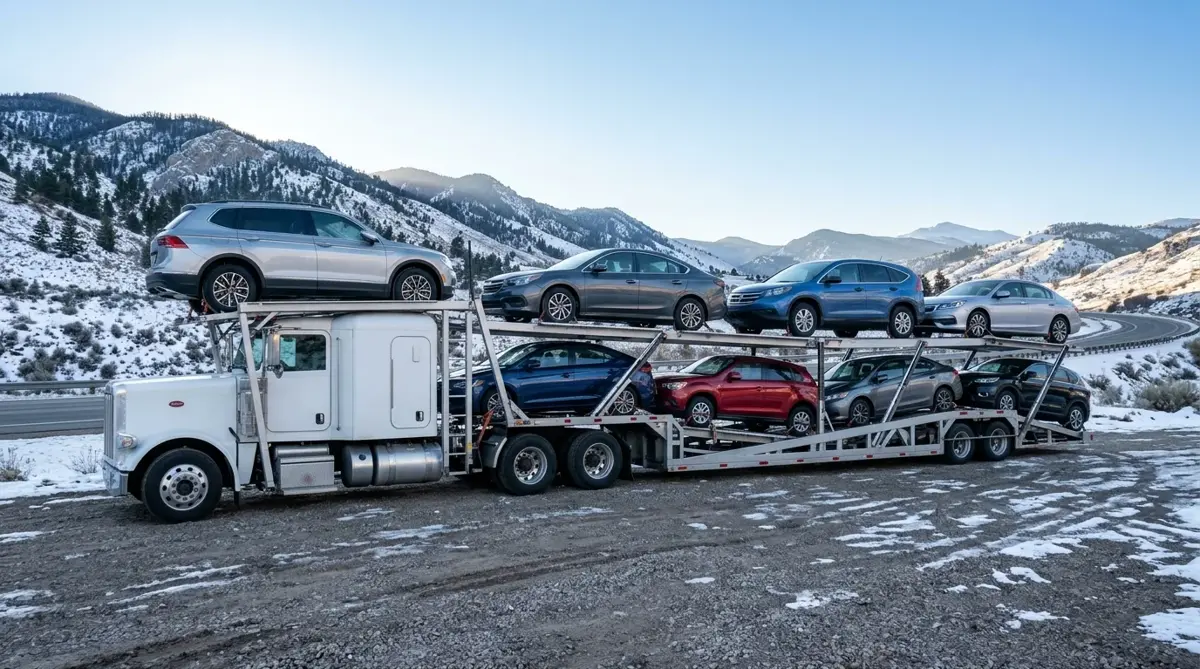
A car carrier is a truck and trailer built to haul assembled vehicles, usually on two decks. An open carrier typically holds about 6 to 9 cars, an enclosed carrier usually fewer, and smaller hot-shot or single-car rigs carry one to a few. Each car is driven or winched on and held at the front and rear by at least two tiedowns.
★ Key Takeaways
- ✓A car carrier, or automobile transporter, is a truck and trailer built to haul assembled vehicles; it is either open (exposed decks) or enclosed (a box trailer).
- ✓An open two-level carrier typically holds about 6 to 9 cars, and a stinger design carries up to three of them over and behind the cab.
- ✓Federal rules let stinger-steered transporters run at least 80 feet long plus a 4-foot front and 6-foot rear overhang, but gross weight is capped at 80,000 pounds, so heavy pickups and EVs can fill a trailer before every slot is used.
- ✓Under 49 CFR 393.128, each car must be restrained at the front and rear with at least two tiedowns; a car that doesn't run has to be winched on, so say so up front.
- ✓Pickup is a window, not a date: drivers fill the trailer, plan stops by weight and drop-off order, and drive under an 11-hour federal limit.
We've been in auto shipping since 1999, and the question we hear right after "what will it cost" is "what does the truck actually look like?" Fair question. You're handing your car to a rig you've probably only passed on the interstate. So let's take one apart: the kinds of car carriers, how many cars each one holds, how your car gets on and stays put, and why it matters for the dates and the price you'll be offered. We'll use one real-world example the whole way through: a crossover going from Denver to Phoenix in January.
Start with the name. Federal highway rules call these rigs automobile transporters, defined as "any vehicle combination designed and used for the transport of assembled highway vehicles." In everyday talk you'll hear car carrier, car hauler, auto transport truck or just "the truck." They come in two big families: open, where the cars ride on exposed decks, and enclosed, where they ride inside a box trailer. Within each family there are smaller rigs, too.
| Rig | Typical capacity | Covered? | Common use |
|---|---|---|---|
| Open two-level carrier (incl. stinger) | About 6–9 cars | No | Most everyday shipments, long routes |
| Enclosed carrier | About 2–10 cars, by trailer | Yes | Classic, exotic, restored or high-value cars |
| Hot-shot (pickup or medium-duty truck with a flat or wedge trailer) | A few cars | No | Shorter routes, single urgent cars |
| Small enclosed trailer (often with a liftgate) | 1–2 cars | Yes | Low or high-value cars that can't take steep ramps |
The one you picture is the open, two-level carrier. Wikipedia's summary of the trade puts it simply: "An American commercial car carrier typically fits between 5 and 9 cars," depending on their size, and open trailers "typically have a double-decker design." Super Dispatch, a vehicle-transport software company, gives six to nine cars for open two-level rigs. On the common stinger design, the trailer hitches low behind the cab and the cab carries cars of its own: up to three can ride over and behind the driver. That's why you'll sometimes see a car perched right above a truck's windshield.
“Capacity explains timing: a driver wants a full trailer before a long run, so your car may wait a few days for the load to fill.”
Length is what makes the stinger work. Under the federal rules in 23 CFR 658.13, a state can't hold a traditional automobile transporter to less than 65 feet overall. The FAST Act then raised the floor for stinger-steered transporters: FHWA says states may not set a length limit of less than 80 feet on them, and that a 4-foot front and 6-foot rear overhang allowance comes on top of that. Those extra feet are the difference between eight cars and nine. Weight still caps the load, though. FHWA notes the overall gross weight may not exceed 80,000 pounds, so a trailer full of full-size pickups or heavy EVs may leave a slot empty that a load of compact sedans would fill.
Ready to ship? Get a real price in 60 seconds.
We put your shipment in front of licensed auto transport companies running your route this week, and they send you their best offers — no obligation, no spam.
Get My Free Quote →Enclosed carriers trade capacity for cover. Wikipedia notes that enclosed trailers have lower capacity, and Super Dispatch gives a wide range for them, from two to 10 cars depending on the trailer. Some are big two-level box trailers; others are smaller one- or two-car trailers behind a pickup or medium-duty truck, often with a liftgate instead of steep ramps. They keep road salt, rain, gravel and sun off the paint, which is why owners of classic, exotic and freshly restored cars choose them. Our enclosed auto transport page goes through when that's worth it, and our open auto transport page covers the everyday option.
Then there are the small open rigs: a heavy-duty pickup or medium-duty truck pulling a flat or wedge-shaped trailer, often called a hot-shot. They carry a few cars at most and tend to run shorter routes, fill gaps on a big rig's schedule or handle a single urgent car. Hot-shot rigs aren't better or worse; they're a different tool, and the company you book with decides what kind of truck runs your route.
Now loading. On an open carrier, most cars are driven up ramps onto the decks, and the driver plans the order before the first car goes on: where each one sits depends on its weight, height and which stop it's going to. Heavier vehicles generally go where they keep the rig balanced and inside axle limits, and the car coming off first can't be buried behind three others. A car that doesn't run has to be pulled on with a winch, which takes extra time and equipment, so always say so when you ask for an estimate. A lowered car may need extra boards to clear the ramp angle.
Once it's in place, the car is strapped down, and that part is spelled out in federal rules. Under 49 CFR 393.128, automobiles, light trucks and vans "must be restrained at both the front and rear" with a minimum of two tiedowns, and tiedowns that go over or around the wheels have to hold the car in every direction: side to side, front to back and up and down. Vehicles over 10,000 pounds fall under the heavier-vehicle rules in 393.130 instead. That's why you'll see straps over the tires or chains at the frame points, and it's one more reason to remove loose items: a car is held by its wheels and frame, not its contents.
Here's our Denver-to-Phoenix crossover in January. It will most likely ride on an open two-level rig with seven or eight other cars headed south. The driver will plan the trip around other pickups and drop-offs, mountain weather on the way out of Colorado and federal driving limits: FMCSA allows 11 hours of driving after 10 consecutive hours off duty. That's why pickup comes as a window, not a promise. Our winter routes guide shows how snow pushes many cross-country carriers onto southern interstates, and the same logic applies on a shorter trip like this one.
What the truck means for you comes down to three things. First, capacity explains timing: a driver wants a full or nearly full trailer before a long run, so your car may wait a few days for the load to fill. Second, the trailer type is your choice: open costs less and is how most cars move, enclosed costs more and keeps the car covered. Third, the truck belongs to the company you book with, so look up its USDOT or MC number on FMCSA's free SAFER Company Snapshot and read your Bill of Lading at pickup and again at delivery. Our guide to reading a quote and our delivery-day inspection guide walk through both.
Here's how it works with us. We put your shipment in front of vetted, licensed auto transport companies, they compete with their best offers, and you choose the one whose truck, dates and terms fit you. You never pay us a cent. Tell us your pickup and delivery ZIP codes, the vehicle, and whether you want open or enclosed, and get your free estimate.
Frequently asked questions
How many cars fit on a car carrier?+
An open two-level carrier typically holds about 6 to 9 cars, depending on their size. Enclosed carriers usually hold fewer, and hot-shot or single-car rigs carry one to a few.
Is my car safer on the top or bottom deck?+
Both decks are held by the same federal tiedown rules. The driver places each car by its weight, height and drop-off order, so you usually don't pick the deck; if you want the car covered, choose an enclosed carrier.
What is a stinger car hauler?+
A stinger is an open car carrier whose trailer hitches low behind the cab, letting the cab carry cars too. FHWA says states may not limit stinger-steered transporters to less than 80 feet, plus overhang allowances.
Can a car that doesn't run go on a car carrier?+
Yes, if the truck has a winch to pull it on and off. Say it doesn't run when you ask for an estimate, because it changes which trucks can take it.
Who owns the truck that ships my car?+
The licensed auto transport company you book with. You can look up its USDOT or MC number for free on FMCSA's SAFER Company Snapshot before you book.
Sources
- Definition of Automobile Transporter (request for comments) — Federal Highway Administration via Federal Register (2017)
- Car carrier trailer — Wikipedia
- Car Carrier Capacity Explained: What Shippers Need to Know — Super Dispatch (2024)
- 23 CFR 658.13: Length — Legal Information Institute, Cornell Law School
- FAST Act Truck Size and Weight Provisions: Questions and Answers — FHWA Office of Freight Management and Operations
- 49 CFR 393.128: What are the rules for securing automobiles, light trucks and vans? — Legal Information Institute, Cornell Law School
- Summary of Hours of Service Regulations — FMCSA
- SAFER Company Snapshot — FMCSA
- Enclosed Auto Transport — American Auto Shipping
- Open Auto Transport — American Auto Shipping
- Shipping a Car Coast to Coast This Winter? Why the Truck May Not Take the Route You Expect — American Auto Shipping
- How to Read an Auto Transport Quote: 7 Lines to Check Before You Book — American Auto Shipping
- Delivery Day: The Ten-Minute Inspection That Decides Whether a Damage Claim Gets Paid — American Auto Shipping
About the Author
Written by the American Auto Shipping team, in auto shipping since 1999. Prices and transit times in our posts are estimates from our published method; the real price comes from the company you book with.