





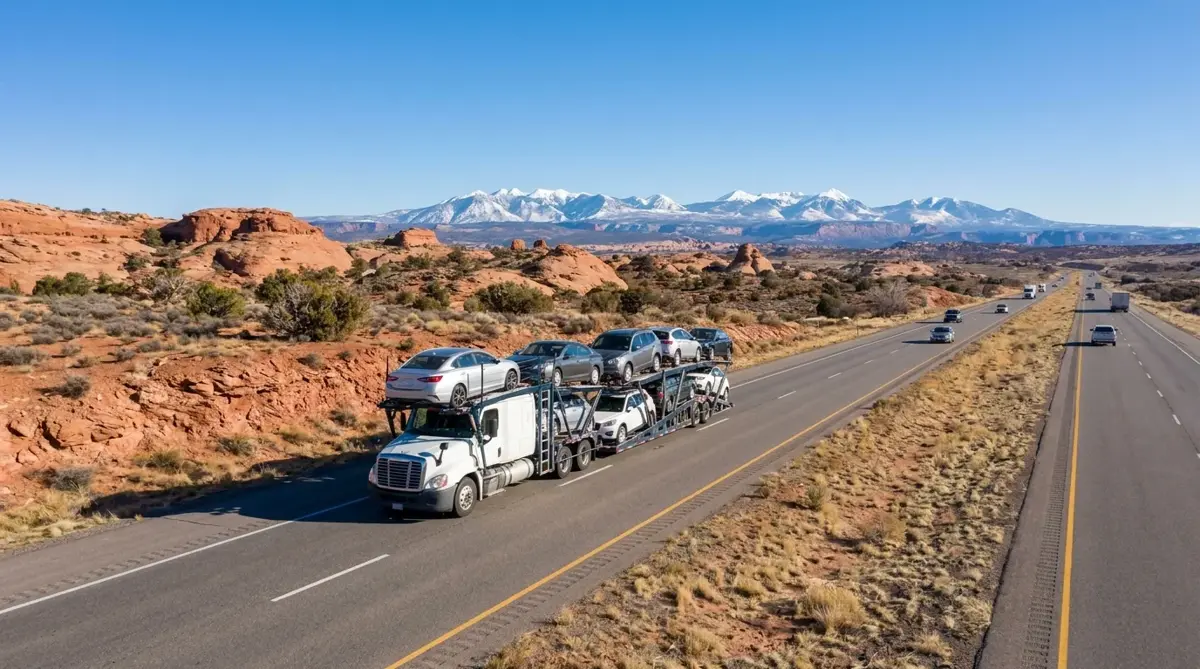
The short answer
In winter, many cross-country car carriers leave I-80 and I-70 for the southern I-40 and I-10 corridors, even when it adds miles, because mountain closures and chain rules can stop a loaded truck for a day or more. By our published method a 2,000-mile shipment takes about 5 to 8 days in transit, and winter detours push it toward the later end. Book two to four weeks ahead and plan delivery a few days before you need the car.
★ Key Takeaways
- ✓In winter, many coast-to-coast car carriers leave I-80 and I-70 for the southern I-40 and I-10 corridors to avoid closures and chain rules, even if it adds miles.
- ✓Wyoming closes parts of I-80 in winter storms, California requires chains on trucks over 6,500 pounds when chain controls are up, and Colorado's I-70 Traction Law runs September 1 through May 31.
- ✓A 2,000-mile trip runs about 5 to 8 days in transit by our published method; winter detours and weather holds push toward the later end.
- ✓Book two to four weeks ahead, ask for delivery a few days before you need the car, and tell the company about any fixed date up front.
- ✓Winter grime can hide scratches: inspect in daylight against your pickup photos, note new damage on the Bill of Lading, then sign.
Ask someone to picture a car going from Chicago to San Francisco and they will usually trace I-80 straight across Iowa, Nebraska, Wyoming, Utah and Nevada. In July, that is often exactly what happens. In January, it often is not. Winter changes the map for the people who drive car carriers, and once you know how, a lot of the questions about timing and dates answer themselves.
Start with the three big east-west corridors in the West. I-80 is the most direct line for the northern half of the country, but it crosses some of the highest, windiest stretches of interstate in the U.S. — southern Wyoming and the Sierra Nevada over Donner Pass. Wyoming regularly closes sections of I-80 in winter storms, and California posts chain controls on its Sierra passes — when they are up, any truck over 6,500 pounds has to chain up to keep going. I-70 through Colorado climbs to the Eisenhower Tunnel and over Vail Pass, where Colorado's Traction Law is in effect every year from September 1 through May 31. I-40 and I-10 run farther south, through New Mexico, Arizona and Texas, and see far fewer closures.
| Corridor | Winter trouble spots | What it can mean for your car |
|---|---|---|
| I-80 | Southern Wyoming wind and snow closures; Donner Pass chain controls | Detours south or weather holds on northern coast-to-coast runs |
| I-70 | Eisenhower Tunnel and Vail Pass; Colorado traction law Sept–May | Slower mountain crossings and possible delays in storms |
| I-40 | Occasional snow in northern Arizona and New Mexico | Often used as a winter alternative to I-80 and I-70 |
| I-10 | Rarely affected by snow | The most predictable winter corridor, but the longest way around for northern cities |
A loaded car carrier is long, heavy and tall, and a driver carrying nine or ten customers' cars cannot afford to sit at a closed gate for a day and a half. Federal hours-of-service rules also cap a truck driver at 11 hours of driving after 10 hours off, so a day spent waiting at a closed gate is a day of driving lost. So when the weather turns, many drivers on coast-to-coast runs drop south to I-40 or I-10 even if it adds a few hundred miles. More miles on a detour usually still means a more predictable trip than waiting out a storm on a mountain pass.
“More miles on a detour usually still means a more predictable trip than waiting out a storm on a mountain pass.”
That has a few effects you will notice. The first is time. By our published estimating method a 2,000-mile trip runs roughly 5 to 8 days in transit, and a winter detour or a weather hold can push the delivery toward the later end of that range or past it. The second is that the dates in your booking are estimates for a reason: a company that promises an exact delivery day in January on a northern route is promising something no driver controls. The third is that your car may be on the truck a day or two longer than it would be in summer — which is why loose items left inside are a bigger risk in winter, not a smaller one.
Ready to ship? Get a real price in 60 seconds.
We put your shipment in front of licensed auto transport companies running your route this week, and they send you their best offers — no obligation, no spam.
Get My Free Quote →So plan with a cushion. If you need the car by a certain date, book two to four weeks ahead and ask for delivery a few days before you actually need it. If you are flying to the destination, have a plan for the first few days without the car. And if your schedule is fixed — a job start, a lease ending, a return flight — tell the company you are considering at the start, so they can tell you honestly how they handle weather on your route.
Ask a couple of route questions when you compare offers. Which way will the truck likely go this time of year? How will they let you know about weather delays, and who will you hear from? There is no single right answer, but a company that has a ready answer to both has clearly done winter runs before.
Prep the car for winter, too. Leave about a quarter tank of fuel, check the battery and the antifreeze, and take out anything loose. If the car is going somewhere cold, consider having winter tires put on before pickup so it is ready to drive when it arrives.
When the car arrives, it may be covered in road grime from a long winter run. Walk around it in daylight, compare it with the photos you took at pickup, note every new scratch or dent on the Bill of Lading, and then sign. If the grime makes it hard to see the paint, take your time and look closely before you sign — that signature records the car's condition at delivery.
How it works with us is simple. We put your shipment in front of vetted, licensed auto transport companies, they compete with their best offers, and you choose the one whose dates, route and price work for you. You book directly with that company, and you never pay us a cent. Moving coast to coast this winter? Get your free estimate early and give the trip a little extra room.
Frequently asked questions
Will my car carrier take I-80 in winter?+
It might, but many drivers on coast-to-coast runs switch to I-40 or I-10 when storms are forecast over Wyoming or the Sierra. Ask the company you are considering which way they expect to go this time of year.
How long does a cross-country car shipment take in winter?+
By our published estimating method, a 2,000-mile trip takes about 5 to 8 days in transit, plus the pickup window. Winter detours and weather holds push it toward the later end, or past it.
Can a company promise a delivery date in winter?+
Delivery dates are estimates on any route, and more so in winter, because road closures and chain controls are outside any driver's control. If your date is fixed, say so before you book.
Should I ship my car open or enclosed in winter?+
Open transport is fine for most daily drivers; the car will just arrive with road grime. Enclosed keeps salt and slush off a classic or fresh paint and costs about 50% more by our published method.
What should I check when my car arrives covered in grime?+
Look it over in daylight against your pickup photos, note every new scratch or dent on the Bill of Lading, and then sign. If the dirt hides the paint, take your time before you sign.
Sources
- CDOT, CSP and safety partners share new Traction Law requirements, winter driving preparedness tips (Nov. 20, 2025) — Colorado Department of Transportation
- Truck Chain Requirements — Caltrans
- Winter conditions cause closures along I-80 and other roads — Wyoming Department of Transportation
- WYDOT Travel Information Service (Wyoming 511) — Wyoming Department of Transportation
- Summary of Hours of Service Regulations — Federal Motor Carrier Safety Administration
- How We Estimate Car Shipping Costs — American Auto Shipping
About the Author
Written by the American Auto Shipping team, in auto shipping since 1999. Prices and transit times in our posts are estimates from our published method; the real price comes from the company you book with.
Learn More About Auto Shipping
Shipping To or From These Areas?
Auto transport by city