





★ Key Takeaways
- ✓8 feet 6 inches is the line. At or under it, your boat moves like any other trailer load. Over it, every state you cross wants a permit.
- ✓Measure the widest point of the hull including rub rails and any fixed hardware -- not the length, and not what the brochure says.
- ✓Escort vehicles commonly become mandatory somewhere around 12 feet of width, though the exact trigger is set state by state and the cost is per escort, per state.
- ✓Permits are issued per state, not per trip. A boat crossing six states needs six permits, which is why identical boats quote very differently depending on the route.
- ✓Oversize loads usually travel in daylight only, often with weekend and holiday curfews, so the transit estimate stretches well beyond what the mileage suggests.
Almost every boat-shipping conversation we have starts the same way. Someone tells us the length. Twenty-four feet, thirty-two feet, whatever it is. Length is the number on the registration and the number in the brochure, so it is the number people reach for. It is also very nearly irrelevant to what the move costs.
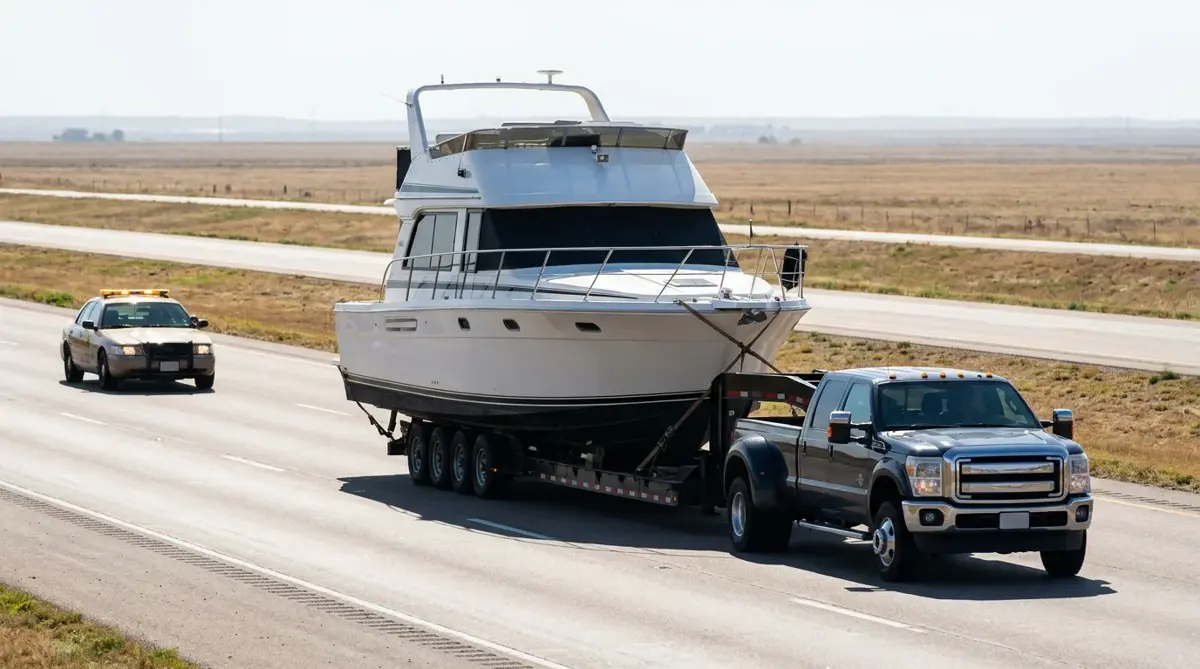
The measurement that decides everything is the beam -- the width at the widest point. Federal rules set the standard legal width for a vehicle on the interstate network at 8 feet 6 inches. Under that, your boat on its trailer is just another load and it moves like one. Over it, by even an inch, it becomes an oversize load, and an oversize load is a different product with different paperwork, different routing, different hours of travel and a different price.
| Beam on the trailer | What it means | Effect on cost and timing |
|---|---|---|
| 8'6" or under | Legal width, no permit | Routine haul, standard transit |
| 8'7" to about 10' | Oversize permit in each state crossed | Permit fees per state, minor delay |
| About 10' to 12' | Permits plus route restrictions | Longer routing, daylight-only travel common |
| About 12' and up | Permits plus escort vehicles | Escort cost per state, meaningfully slower |
| Over about 14' | Escorts plus police in some states | Specialist carriers only, book far ahead |
That cliff is why two boats of the same length can quote hundreds of dollars apart. A 28-foot centre console with a 9-foot beam and a 28-foot boat with an 8-foot-4 beam are not the same job. One needs a permit in every state it crosses. The other does not need any.
“Nobody quotes a boat off its length. They quote it off its width, and the widest point is rarely where the owner thinks it is.”
Measure it yourself before you request anything, and measure the real thing rather than the specification. The published beam is the hull. What actually travels down the road is the hull plus rub rails, plus any fixed hardware that sticks out, sitting on a trailer that may itself be wider than the boat. Take a tape to the widest physical point of the whole assembly as it will sit on the road. That number is what a carrier prices against, and getting it wrong by two inches is the single most common reason a boat quote gets revised after booking.
Ready to ship? Get a real price in 60 seconds.
We put your shipment in front of licensed auto transport companies running your route this week, and they send you their best offers — no obligation, no spam.
Get My Free Quote →Once you are over the line, the cost structure changes in a way worth understanding. Permits are issued per state, not per trip. A boat going from Florida to Texas crosses four states and needs four permits. The same boat going Florida to Michigan crosses more, and costs more, for no reason other than geography. This is why route matters far more on an oversize boat move than on a car, and why a quote that looks high may simply be counting states honestly.
Escort vehicles are the next step up, and they are where the number starts to climb properly. Somewhere in the region of 12 feet of width, most states begin requiring a pilot car running ahead of or behind the load. The exact trigger varies -- states set their own thresholds and they do not agree with each other -- but the practical effect is consistent: you are now paying for an extra vehicle and an extra driver for every mile of every state that demands one. Above roughly 14 feet, some states add police escorts on certain roads, and at that point you are in genuine specialist territory.
The part people underestimate is time rather than money. Oversize loads generally travel in daylight only. Many states add curfews around weekends and public holidays, and most large metros restrict movement during rush hours. A route a car would cover in three days can take a wide boat a week, not because anything went wrong but because the load is legally parked for most of every day. If you need the boat somewhere by a date, build that in from the start.
Height deserves a mention even though beam usually governs. Standard clearance is generally 13 feet 6 inches, with some western states allowing 14. A boat sitting high on its trailer, or one with a tower or hardtop that does not come off, can breach that before the beam becomes an issue. If yours has a removable tower, removing it is often the cheapest single thing you can do to the quote.
What we would tell anyone starting this: get the beam measured properly, then send the request and let licensed companies make their offers. Oversize boat work is specialised, and the carriers who do it well are a much smaller group than the general auto-transport pool. Seeing which of them actually want your route -- and what they will do it for -- is worth considerably more than a single number from a single company that may or may not have run that corridor before.
The boat will get there. It is a solved problem, moved thousands of times a year. It is just a problem where one measurement does most of the work, and it pays to know that measurement before anyone quotes you.
About the Author
Written by the American Auto Shipping team, in auto shipping since 1999. Prices and transit times in our posts are estimates from our published method; the real price comes from the company you book with.