




★ Key Takeaways
- ✓Federally authorised carriers must carry cargo insurance, but the amount varies -- commonly $100,000 to $250,000 for the whole load, not per vehicle.
- ✓Ask for the certificate of insurance before pickup. A legitimate carrier will send it without hesitating.
- ✓Personal items left in the vehicle are almost never covered, by anyone, at any price.
- ✓Damage claims live or die on the Bill of Lading. Photograph the car at pickup and at delivery, and never sign a clean delivery receipt for a damaged vehicle.
- ✓Your own auto policy may cover transport gaps -- worth one phone call to your agent before the truck arrives.
Every company in this industry will tell you your vehicle is insured during transport. It is technically true almost every time, and it is also close to useless as information, because it does not tell you the amount, the deductible, or the list of things the policy quietly excludes. We would rather give you the version we would want if it were our own car sitting on that trailer.
Start with what is required. Carriers with federal operating authority must carry cargo insurance to keep that authority. That is a real protection and it is why we will not distribute a shipment to a carrier without active authority. But the required amount covers the load, not your specific car, and it commonly sits somewhere between $100,000 and $250,000 for a full trailer. On a trailer carrying nine vehicles, that maths matters. It is usually fine. It is worth understanding rather than assuming.
| Item | Usually covered | Notes |
|---|---|---|
| Damage caused in loading or unloading | Yes | The most common legitimate claim |
| Damage in transit from carrier negligence | Yes | Road debris is often excluded -- ask |
| Personal belongings inside the vehicle | No | Effectively never covered |
| Pre-existing damage | No | This is why the pickup inspection matters |
| Acts of nature (hail, flood, fire) | Sometimes | Depends on the policy; ask directly |
| Mechanical failure not caused by transport | No | A car that would not start before will not start after |
The single most useful thing you can do costs you one email. Ask the carrier for their certificate of insurance before pickup. Any legitimate operator sends it without a second thought -- it is a routine request they get constantly. Hesitation, excuses, or a document that expired four months ago all tell you something important while you can still act on it.
“The Bill of Lading is the whole case. If the damage is not on it, proving when it happened is very close to impossible.”
Now the part nobody enjoys hearing. Personal belongings left in the vehicle are not covered. Not by the carrier's cargo policy, not usually by your own auto policy, not by anyone. People put boxes in the back seat every day because it seems like free shipping, and most of the time nothing happens. When something does happen, there is no claim to make. If it would upset you to lose it, it should not be in the car.
Ready to ship? Get a real price in 60 seconds.
We put your shipment in front of licensed auto transport companies running your route this week, and they send you their best offers — no obligation, no spam.
Get My Free Quote →When damage does occur, the case is won or lost on a single document. The Bill of Lading is the inspection report you and the driver sign at pickup, noting the vehicle's condition. It is the baseline that every later claim is measured against. If a scratch is not recorded at pickup and appears at delivery, that is a claim. If the paperwork at pickup was rushed and vague, proving when the damage happened becomes very close to impossible.
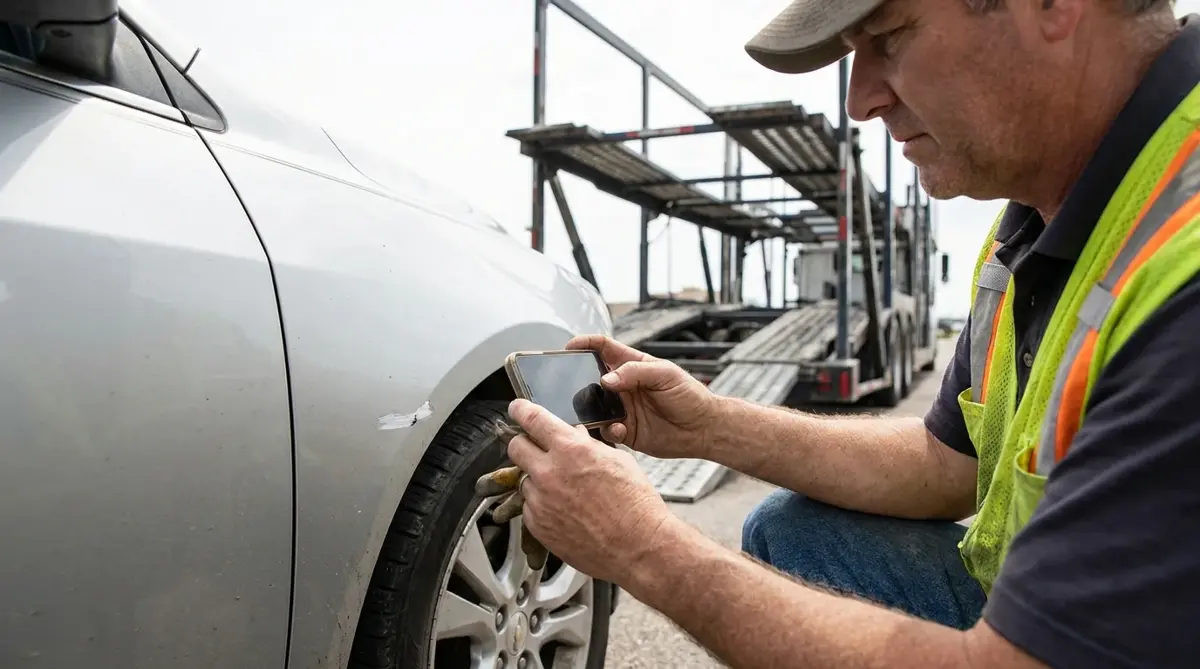
So do the inspection properly, even though the driver is on a schedule and you feel rude taking your time. Walk the car in daylight if you can. Photograph every panel, both bumpers, the wheels, the roof, and the odometer. Get the driver's copy of the signed condition report before the truck leaves. It takes ten minutes and it is the only ten minutes that matters if something goes wrong.
Do the same thing at delivery, and here is the part people get wrong under pressure: do not sign a clean delivery receipt for a damaged vehicle. The driver may be in a hurry. You may be tired. Signing that the car arrived in good condition when it did not is signing away the claim. Note the damage on the delivery paperwork, photograph it before the truck pulls away, and start the claim the same day.
One more call worth making. Your own auto insurance may cover some transport scenarios, and policies differ enough that we cannot tell you whether yours does. Your agent can, in about four minutes. It is a free phone call that occasionally turns out to matter a great deal.
None of this is a reason to be nervous about shipping a car. The overwhelming majority of vehicles arrive exactly as they left. It is a reason to spend ten minutes on the paperwork rather than two, and to ask one question about insurance before pickup rather than after delivery. When you get offers through American Auto Shipping you can see each carrier's authority status and safety record before you choose, which is the other half of the same job -- knowing who is actually driving away with your car.
About the Author
American Auto Shipping
Dave Armstrong is one of American Auto Shipping's longest-tenured team members. As content manager and strategist, most of what you read on this website came from him. He has extensive knowledge of the auto transport industry, having spent time in every role the business has to offer.