





★ Key Takeaways
- ✓Cars travel by roll-on/roll-off vessel from a West Coast port. You drive it on; it is secured below deck.
- ✓Budget roughly $1,000 to $1,800 from the West Coast, and more from inland states because you are paying for two moves -- ground to the port, then ocean.
- ✓The vehicle must be operable. Non-running cars need special arrangements and cost considerably more.
- ✓An agricultural cleaning inspection is mandatory. Soil, seeds and plant material on the undercarriage will fail you and cost you a sailing.
- ✓Total door-to-door is commonly three to five weeks from an inland origin. Vessels sail on a schedule, and missing one costs you a week.
People treat Hawaii like a long domestic move that happens to end with a boat. It is the other way round. It is an ocean shipment with a domestic move bolted onto the front, and almost everything that goes wrong goes wrong because somebody planned it as the former.
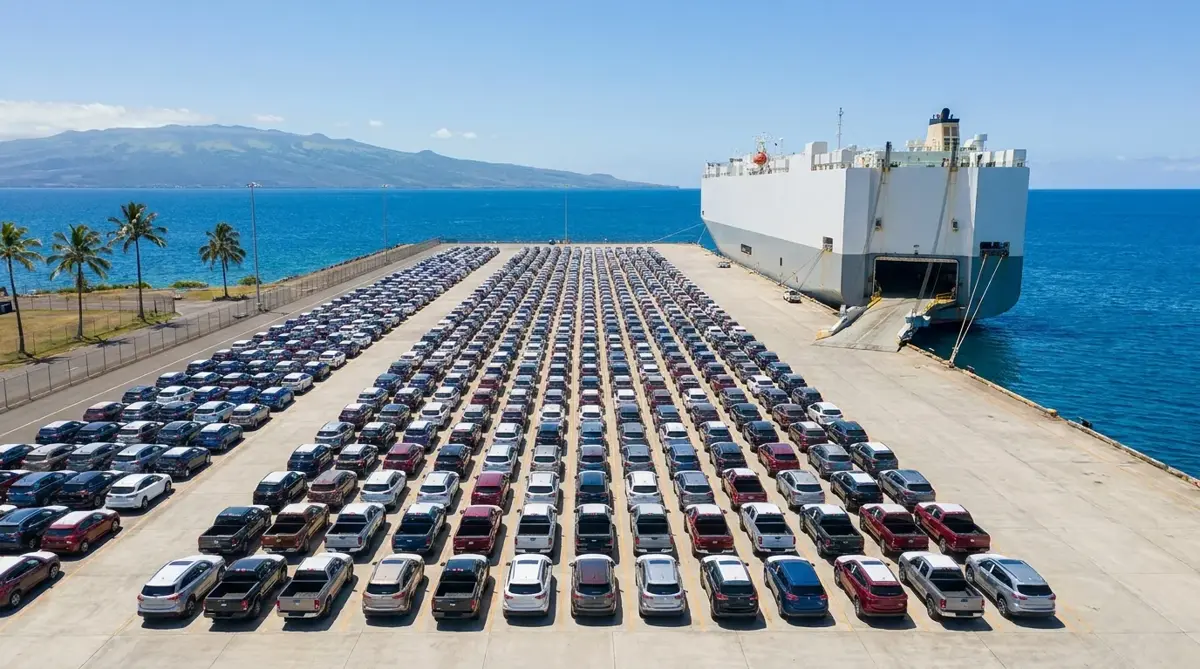
Here is the shape of it. Vehicles cross by roll-on/roll-off vessel -- you drive the car onto the ship and it is secured below deck, the same way it would be on a ferry, except the crossing is several days. RoRo is the normal method and the reasonable one. Container shipping exists and costs substantially more; it is worth it for a genuinely rare or high-value vehicle and unnecessary for a Corolla.
| Origin | Typical total cost | Door-to-door time |
|---|---|---|
| Los Angeles / Long Beach | $1,000 - $1,500 | 2 - 3 weeks |
| Oakland / Bay Area | $1,000 - $1,500 | 2 - 3 weeks |
| Seattle / Tacoma | $1,100 - $1,600 | 2 - 3 weeks |
| Phoenix or Las Vegas | $1,400 - $2,000 | 3 - 4 weeks |
| Texas or the Midwest | $1,800 - $2,600 | 3 - 5 weeks |
| East Coast | $2,200 - $3,200 | 4 - 6 weeks |
Cost depends far more on where you start than most people expect, because you are buying two moves. The ocean leg is relatively fixed. The ground leg from your driveway to the port is a normal car shipment and priced like one. From Los Angeles or Oakland you are mostly paying for the ocean. From Ohio you are paying for a cross-country haul plus the ocean, and the total roughly doubles.
“The vessel does not wait. A car that fails the agricultural inspection on Tuesday sails the following week, not that afternoon.”
Two rules catch people out, and both are worth knowing before you book rather than after.
Ready to ship? Get a real price in 60 seconds.
We put your shipment in front of licensed auto transport companies running your route this week, and they send you their best offers — no obligation, no spam.
Get My Free Quote →The first is that the vehicle must be operable. It has to start, steer, and roll under its own power, because someone is going to drive it onto the ship. A non-running car is not impossible but it needs special handling, costs considerably more, and has to be arranged deliberately rather than discovered at the terminal.
The second is the agricultural inspection, and this is the one that actually ruins schedules. Hawaii takes invasive species extremely seriously, with good reason. Your vehicle will be inspected for soil, seeds, insects and plant material -- and the undercarriage and wheel wells are exactly where a car that has spent its life on mainland roads carries all of it. A failed inspection does not mean a warning. It means the car does not sail, and the next vessel is typically a week out.
So clean the car properly, and understand that we mean the parts you cannot see. A normal car wash does not do it. Pressure-wash the undercarriage, the wheel wells, and inside the bumpers. Empty the boot completely. If there is a spare tyre well, clean that too. We have seen shipments delayed a full week over dried mud in a wheel arch, which is a genuinely miserable way to lose seven days of a relocation.
On timing, work backwards from the sailing rather than forwards from your moving date. Vessels run on a published schedule and they leave without you. Build in a buffer between the car reaching the port and the ship departing -- a few days, not a few hours. If your flight is on the 15th, your car should be at the port well before the 15th, and you should expect to be without it on the island for a week or two after you land.
Also worth knowing: your car cannot be a moving box. Personal belongings are not permitted in vehicles on RoRo vessels, and this is enforced far more strictly than on a domestic truck. Ship your things separately.
None of this is difficult once you know it. It is just genuinely different from mainland shipping, and the people who have a bad time are almost always the ones who assumed it would be the same. Get quotes for the full door-to-port-to-door move rather than pricing the legs separately -- the companies we work with handle the ground portion and connect to the ocean carriers, so you can see the whole number in one place instead of assembling it yourself.
About the Author
American Auto Shipping
Dave Armstrong is one of American Auto Shipping's longest-tenured team members. As content manager and strategist, most of what you read on this website came from him. He has extensive knowledge of the auto transport industry, having spent time in every role the business has to offer.
Learn More About Auto Shipping
Shipping To or From These Areas?
Auto transport by city