





★ Key Takeaways
- ✓Salt and brine go down on northern roads from roughly mid-November through March, so a car that ships north in October arrives before the worst of it.
- ✓On an open carrier your car rides on the same highways as everyone else and picks up the same spray. Enclosed transport keeps it off the car entirely.
- ✓Wash the undercarriage within a few days of delivery, and again every couple of weeks while the roads are salted.
- ✓A car that has lived its whole life in Arizona, Texas or Florida has never needed rust protection. Have it treated before its first northern winter, not after.
- ✓A coat of road film can hide fresh scratches at delivery. Ask for daylight or a light, and wipe a panel if you are not sure what you are looking at.
Every fall we hear from people moving a car from the Sun Belt to somewhere that actually has winter — a job in Chicago, a kid starting school in Boston, retirees heading back to Michigan for the holidays. The shipping part is routine. What catches people off guard is what happens after the car arrives: a car that has never seen a salted road is about to meet one every day for four months.
Here is the timing that matters. Most northern states start putting down salt and brine as soon as the first cold snap threatens ice, which usually means somewhere between mid-November and early December, and they keep at it into March. Brine is sprayed on the road before a storm, so the pavement can be wet with it on days when there is no snow at all. If your dates are flexible, a car that ships north in October or the first half of November arrives on dry roads and gets a few weeks to settle in before the salt trucks come out.
| Mistake | Why it costs you | Do this instead |
|---|---|---|
| Shipping north in January | The car arrives on salted roads and spends its first week under slush | Ship in October or early November if your dates allow |
| Skipping the first wash | Salt keeps working on brake lines and seams long after the drive | Rinse the undercarriage within a few days of delivery |
| Assuming a southern car is protected | Cars from dry states often have no undercoating at all | Have it rustproofed before the first northern winter |
| Inspecting a salt-filmed car at dusk | Grime and film hide new scratches | Inspect in daylight and wipe any panel you are unsure about |
| Shipping a classic on an open trailer in winter | Road spray reaches every car on the load | Choose enclosed transport for anything you would not drive in the snow |
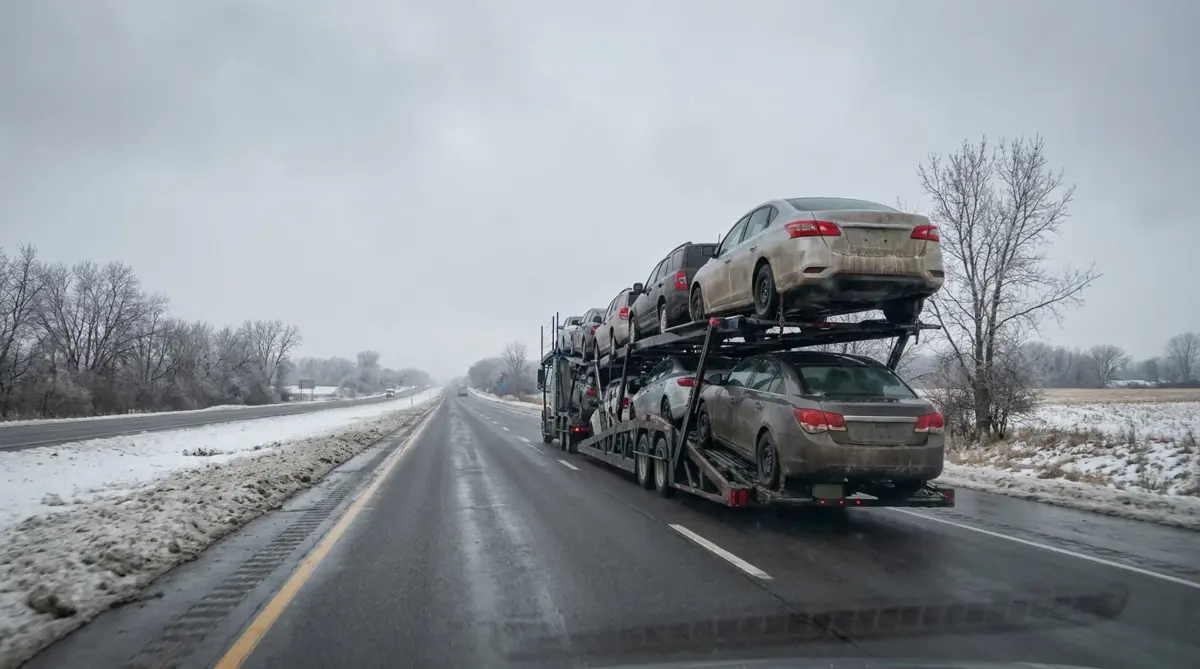
Next, think about what your car rides through on the way. On an open carrier your car sits on the same interstates as every other vehicle, and whatever is on the road — rain, slush, brine mist — reaches it too. In fair weather that is just road dust, and a wash takes care of it. In a salt-belt winter it means the car can arrive with a gray film over the paint and wheels. Enclosed transport keeps the car inside a trailer the whole way, which is why it is the usual choice for classics, collector cars and anything freshly restored. It costs more, and for a daily driver in October it is rarely worth it. For a vintage car going to Minnesota in January, it usually is.
“A car that spent ten years in Phoenix can pick up more corrosion in one Michigan winter than it did in its whole life. The trip north is the easy part — the first salt season is what you plan for.”
The biggest risk is the car itself. A vehicle that has spent its whole life in Arizona, Texas, Nevada or Florida often has no undercoating, no cavity wax and no reason to have ever needed them. Brake lines, fuel lines, rocker panels and the seams behind the bumpers are where salt does its damage, and they are exactly the places a dry-climate car has never had to defend. If your car is going north for good, have a local shop apply rust protection before the first winter. It is far cheaper than replacing brake lines two years from now.
Ready to ship? Get a real price in 60 seconds.
We put your shipment in front of licensed auto transport companies running your route this week, and they send you their best offers — no obligation, no spam.
Get My Free Quote →Then there is the week the car arrives. Rinse the undercarriage within a few days of delivery, even if it looks clean — salt is invisible once it dries. Plenty of car washes in salt country have an underbody spray for exactly this reason. Keep doing it every couple of weeks while the roads are being treated, and give the car a thorough wash in spring once the salt trucks park for the year.
Delivery day has one winter-specific trap. A car covered in road film can hide a fresh scratch or chip, and a winter delivery often happens in the late afternoon when the light is already going. Do what we tell everyone: walk around the car in daylight or ask the driver to pull under a light, compare it against your pickup photos, and if a panel looks off, wipe it with a damp cloth before you decide. Write any new damage on the Bill of Lading, then sign. If you notice something later, file the claim directly with the company you booked — their cargo insurance is what covers transit damage.
A few other things are worth doing before a car heads into its first real winter. Check the tires — all-season tires that were fine in Phoenix may not be enough on packed snow, and many drivers in the upper Midwest switch to winter tires. Make sure the coolant is rated for real cold, since a southern car may have been topped up with a mix that was never tested below freezing. And test the battery; a battery that starts reliably at 90 degrees can struggle at 10.
None of this changes how you ship. We put your shipment in front of vetted, licensed auto transport companies, they compete with their best offers, and you choose the company and book directly with them. What changes is when you book and how you plan for the car's first season up north. If you can ship before the salt goes down, do it. If you can't, plan the first wash and the rustproofing appointment before the car ever arrives.
Moving a car north this fall? Get your free estimate and compare offers — and if your dates are flexible, ask the companies what an October pickup looks like on your route before the winter rush pushes pickup windows out.
About the Author
American Auto Shipping
Dave Armstrong is one of American Auto Shipping's longest-tenured team members. As content manager and strategist, most of what you read on this website came from him. He has extensive knowledge of the auto transport industry, having spent time in every role the business has to offer.