




★ Key Takeaways
- ✓Choose enclosed transport for any classic, exotic, show car, or vehicle worth more than $50,000 to avoid road debris, weather, and UV exposure.
- ✓Enclosed transport typically costs 40–60% more than open (a $1,200 open run becomes $1,800–$2,000 enclosed) — a rounding error against a high-value car.
- ✓Standard carrier liability is usually $250,000–$500,000 per load, not per vehicle; arrange supplemental coverage (up to $1 million per vehicle is available) for high-value cars.
- ✓Prep properly: secure loose accessories, charge the battery, confirm no fluid leaks, and remove all valuables.
- ✓Book major events 4–6 weeks out — enclosed carriers to Monterey Car Week are booked solid by early June and Scottsdale by November.
April through October is car show season in America, and right now — late April — is when the phone calls start pouring in from collectors, restorers, and enthusiasts who need their prized vehicles shipped to shows, auctions, and events across the country. We’ve been helping people ship classic and exotic cars since 1999, and I’ll tell you straight: transporting a show car is not the same as shipping a daily driver. The stakes are different, the requirements are different, and the consequences of cutting corners are different. A door ding on your commuter car is annoying. A door ding on your matching-numbers ’69 Camaro is devastating.
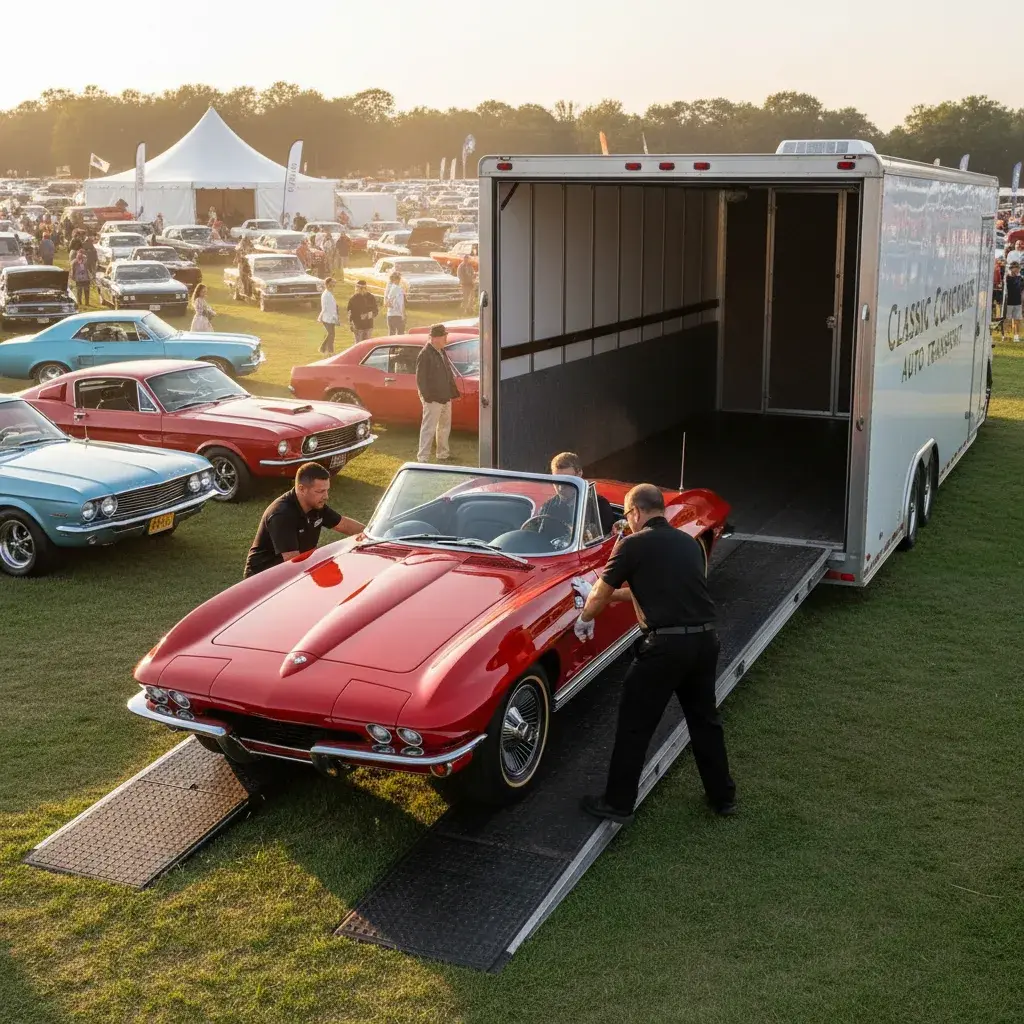
Let’s start with the most important decision: enclosed transport. If your vehicle is worth more than $50,000, is a classic, an exotic, a show car, or has any kind of custom paint or restoration work, you need enclosed transport. Full stop. I don’t care what anyone else tells you about open transport being “fine.” Open carriers expose your vehicle to road debris, weather, UV exposure, and the general grime of highway travel. I’ve seen a rock chip from a passing truck put a quarter-sized mark in a $30,000 paint job. I’ve seen brake dust from the car above on a double-deck carrier settle into fresh clearcoat. Enclosed transport eliminates all of that. Your vehicle rides in a fully enclosed trailer, protected from the elements and road hazards.
Now, enclosed transport costs more — typically 40–60% more than open transport for the same route. A cross-country open transport run that costs $1,200 might be $1,800–$2,000 enclosed. But here’s the way I think about it: if your car is worth $75,000 or $150,000 or $500,000, the difference between open and enclosed is a rounding error compared to the value you’re protecting. It’s like buying insurance — the premium seems like a lot until you need it. And unlike insurance, enclosed transport actively prevents the damage rather than just compensating you after the fact.
“A door ding on your commuter car is annoying. A door ding on your matching-numbers '69 Camaro is devastating.”
Insurance is the other critical piece. Standard carrier liability coverage is typically $250,000–$500,000 per load, not per vehicle. If you’re shipping a vehicle worth more than that — and plenty of classics and exotics are — you need supplemental coverage. Ask about it explicitly. Some enclosed carriers offer up to $1 million in coverage per vehicle for high-value shipments, and specialty insurers who understand collector vehicles can add gap coverage. Don’t assume your personal auto insurance or homeowner’s policy covers transport damage — most don’t, or they have exclusions for vehicles in transit.
Ready to ship? Get a real price in 60 seconds.
We put your shipment in front of licensed auto transport companies running your route this week, and they send you their best offers — no obligation, no spam.
Get My Free Quote →Prep your vehicle properly before shipping. This sounds basic but I can’t tell you how many times I’ve seen issues that could have been prevented. Remove or secure any loose accessories — spoilers that aren’t bolted down, antenna masts, removable mirrors. If your classic has chrome bumpers that aren’t attached securely, tighten them. Make sure the battery is charged and the vehicle starts — carriers need to load and unload under the car’s own power in most cases. Check your fluids and make sure there are no active leaks — a leaking vehicle can damage other vehicles on the same trailer and carriers can refuse to load it. And for the love of everything, do not leave valuables in the car. I know that sounds obvious, but I’ve seen people leave tool kits worth thousands of dollars in their classic’s trunk.
Timing matters enormously for car show shipping. The major shows — Amelia Island, Pebble Beach, Monterey Car Week, Hershey, Scottsdale Auction Week — create massive spikes in enclosed transport demand in their respective regions. If you’re shipping to Monterey Car Week in August, don’t wait until July to book. Enclosed carriers headed to the Monterey Peninsula that week are booked solid by early June. Same with Scottsdale in January — you need to be booking by November. I’ve seen collectors miss shows because they couldn’t get transport arranged in time. Plan ahead by at least 4–6 weeks for any major event.
Let me talk about the drivers for a second, because this matters. The best enclosed transport drivers are specialists. They’ve been hauling high-value vehicles for years, they know how to soft-tie a lowered car without damaging the bodywork, they know how to navigate tight driveways and event venues, and they treat every car like it’s worth a million dollars — because some of them are. When you compare offers through American Auto Shipping, look for carriers with specific experience with high-value vehicles: maintained equipment, trailers with lift gates for low-clearance vehicles, and the right insurance. This isn’t the same carrier pool that hauls Honda Civics from auction to dealer lots.
One thing collectors often ask about is door-to-door service for show cars. Here’s the reality: enclosed trailers are large — typically 53 feet. They cannot access every residential street or event venue directly. A good carrier will get as close as physically possible and communicate with you about the exact delivery location. For show venues, there’s usually a designated vehicle check-in area where transporters unload. For home pickup, if your street is too narrow or has low-hanging trees, the carrier will arrange a nearby meeting point. This is standard and not a red flag — it’s just the physics of operating a large enclosed trailer.
Documentation is even more critical with high-value vehicles. Beyond the standard Bill of Lading, I recommend a detailed condition report with high-resolution photos of every panel, every piece of chrome, every wheel, and the interior. Have the driver sign off on the condition at both pickup and delivery. If your vehicle has been judged or appraised recently, have that documentation available. In the unlikely event of a damage claim, having a recent professional appraisal makes the process dramatically smoother than trying to establish value after the fact.
At American Auto Shipping, we’ve helped people ship everything from barn-find project cars to multi-million-dollar concours winners. We put your shipment in front of vetted, licensed enclosed carriers, they compete with their best offers, and you choose the one you book with — because shipping a show car isn’t just logistics, it’s personal. These vehicles represent years of searching, restoring, and investing, and we get that. If you’ve got a show coming up and a vehicle to get there, get your free estimate now and get your car to the show in the same condition it left your garage.
About the Author
American Auto Shipping
Dave Armstrong is one of American Auto Shipping's longest-tenured team members. As content manager and strategist, most of what you read on this website came from him. He has extensive knowledge of the auto transport industry, having spent time in every role the business has to offer.