





The short answer
Ship a classic to winter storage on an enclosed carrier, which keeps it out of late-fall salt and slush and costs about 50% more than open by our published method. Ship with about a quarter tank, then fill the tank and add fuel stabilizer at the storage location. Take dated photos before pickup, because the spring trip home is a separate shipment with its own Bill of Lading.
★ Key Takeaways
- ✓Enclosed transport keeps a collector car out of late-fall salt and grime; it costs about 1.5 times the open price in our published estimating method.
- ✓Ask about liftgate loading and soft wheel straps, and mention a low front lip, lowered suspension or a car that must be pushed.
- ✓Ship with about a quarter tank; top off and add stabilizer at the storage location, or follow the facility's rules.
- ✓A car that cannot drive on and off the trailer ships as inoperable, about 20% more by our published method.
- ✓Take dated photos before the fall pickup and keep them for the spring trip home, which is a separate shipment with its own Bill of Lading.
Somewhere around late October, a lot of garages up north have the same conversation. The last cruise night is over, the leaves are on the driveway, and the classic needs somewhere to sleep for five months. For some people that is the back of the garage under a cover. For a growing number it is a climate-controlled storage facility across the state — or a garage in Arizona or Florida where the car can actually come out on a sunny January afternoon. Either way, the car has to get there, and it has to come back in the spring the way it left.
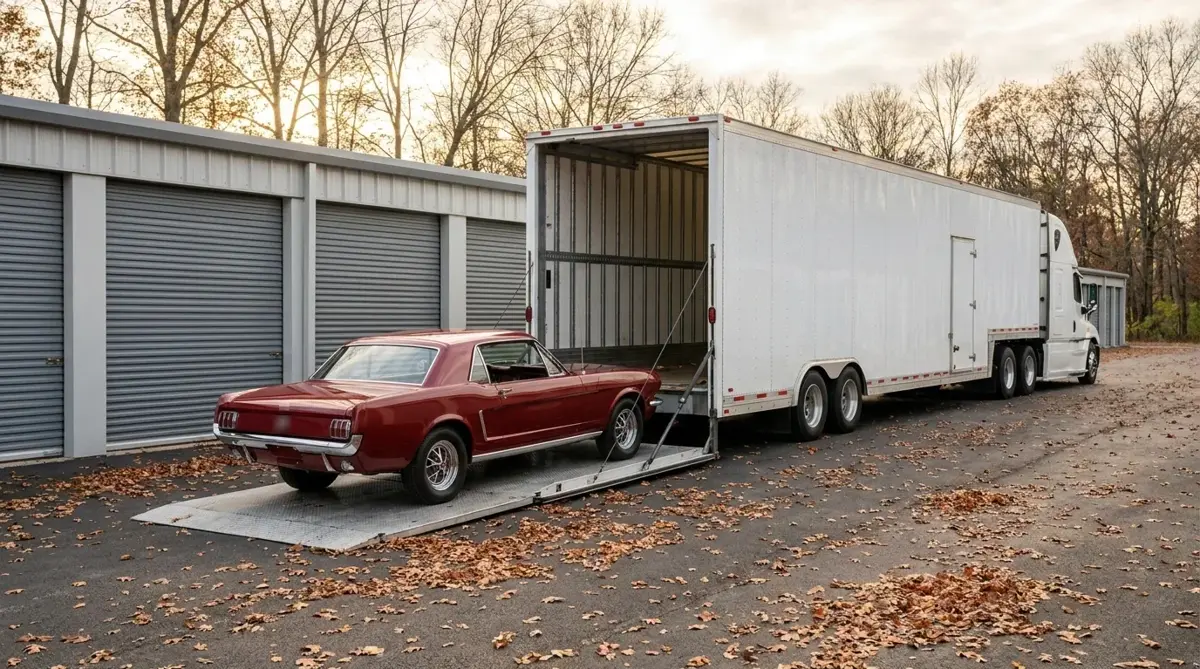
Start with how it should travel. For most collector cars we suggest enclosed transport. An open carrier is fine for a daily driver, but a classic with original paint, chrome and a soft top is better off out of the road salt, slush and gravel that late-fall routes throw around. Enclosed costs more — about 1.5 times the open price in our published estimating method — but for a car you plan to keep for years, most owners think it is money well spent.
| Step | What to do | Why it matters |
|---|---|---|
| Transport type | Enclosed for original paint and chrome | Keeps the car out of late-fall salt, slush and gravel |
| Loading | Ask about liftgate and soft wheel straps | Protects low spoilers, overhangs and the frame |
| Fuel | About a quarter tank to ship; stabilizer at storage | Less weight on the truck, fresh fuel in the spring |
| Running condition | Say up front if it does not run | Inoperable cars need a winch and cost more |
| Photos | Dated photos of every side before pickup | A record for both the fall delivery and the spring return |
Ask how the company loads and secures low or valuable cars. Many enclosed carriers use a hydraulic liftgate instead of steep ramps, which matters for a car with a low front spoiler or long overhangs. Ask whether they strap over the tires with soft wheel straps rather than chaining to the frame, and tell them about anything unusual — a lowered suspension, a fragile front lip, a car that has to be pushed. A good company will want to know before the truck arrives.
“The car has to get there, and it has to come back in the spring the way it left.”
Then prep the car for the trip and for the months after it. For shipping, leave about a quarter tank of fuel and take out anything loose. For storage, plan to top off the tank and add a fuel stabilizer once the car is at its winter home, or follow whatever the facility recommends. Ask the facility how they want the battery handled — Hagerty suggests a battery maintainer where there is power, or disconnecting the negative terminal where there is not — add 2 to 5 pounds of air to the tires to make up for slow loss, and note anything the car needs when it wakes up: an oil change, a new battery, a slow leak you have been watching.
Ready to ship? Get a real price in 60 seconds.
We put your shipment in front of licensed auto transport companies running your route this week, and they send you their best offers — no obligation, no spam.
Get My Free Quote →If the car does not run, say so when you book. A car that cannot drive on and off the trailer ships as inoperable, which needs a truck with a winch and costs more — about 20% more in our published estimating method. It is far better to plan for that than to have a driver arrive expecting a car that starts.
Document the car carefully, twice. Before pickup, take dated photos of every panel, the roof, the wheels, the interior and the odometer, plus close-ups of any chips or scratches already there. Keep them somewhere you will find them in April. The return trip in the spring is a second shipment with its own Bill of Lading, so you want a clear record of what the car looked like in October.
Check the paperwork side too. Ask your insurer how the car is covered while it is on a truck and while it sits in storage, and ask the facility what they require from you. If the car is going out of state for the season, check whether that changes anything for your registration or insurance at home.
At delivery — to the storage facility in the fall and back to your garage in the spring — walk around the car in good light, compare it with your photos, note every new scratch or dent on the Bill of Lading, and then sign. That signature records the car's condition when it arrived, so take the time even if the facility is busy.
How it works with us is simple. We put your shipment in front of vetted, licensed auto transport companies, they compete with their best offers, and you choose the one whose equipment, dates and price suit your car. You book directly with that company, and you never pay us a cent. Putting the classic away for the season? Get your free estimate — and while you are at it, ask about the trip home in the spring.
Frequently asked questions
Should a classic go to storage on an open or enclosed carrier?+
For original paint, chrome or a soft top, enclosed is the safer choice in late fall, when routes are wet and salty. It costs about 50% more than open by our published method.
How much fuel should be in a classic when it ships?+
About a quarter tank for the trip. Once it is at its winter home, fill the tank and add fuel stabilizer, or follow the storage facility's rules.
What if my classic doesn't run?+
Say so when you book. It ships as inoperable on a truck with a winch, which costs about 20% more by our published method.
Is the spring trip home part of the same shipment?+
No. The return is a separate shipment with its own Bill of Lading, so keep your fall photos to compare against in the spring.
How do I check the company that will carry my car?+
Look up its USDOT or MC number on FMCSA's SAFER Company Snapshot to see its registration before you book.
Sources
- The best tips for winter car storage and care — Hagerty
- 5 essentials that allow your classic to sleep peacefully when the snow falls — Hagerty
- SAFER Web — Company Snapshot — Federal Motor Carrier Safety Administration
- How We Estimate Car Shipping Costs — American Auto Shipping
About the Author
Written by the American Auto Shipping team, in auto shipping since 1999. Prices and transit times in our posts are estimates from our published method; the real price comes from the company you book with.