





★ Key Takeaways
- ✓US vehicle repossessions are on pace for their highest totals since the 2009-2010 financial-crisis era -- millions of units a year flowing back to lenders and onto auction blocks.
- ✓That inventory shows up at auctions and remarketing lots nationwide, which means the best price on the car you want is increasingly in another state.
- ✓Auction and repo lots charge daily storage after a short free window -- often $25-$75 a day -- so transport needs to be booked before you win, not after.
- ✓A gate release, lot/stock number, and buyer authorization are what the carrier needs to pick up from an auction; a non-running unit needs a winch-equipped truck (typically +$100-$200).
- ✓Open transport for an auction win typically runs $400-$700 regional and $1,000-$1,400 cross-country -- usually a fraction of the discount that made the auction car worth buying.
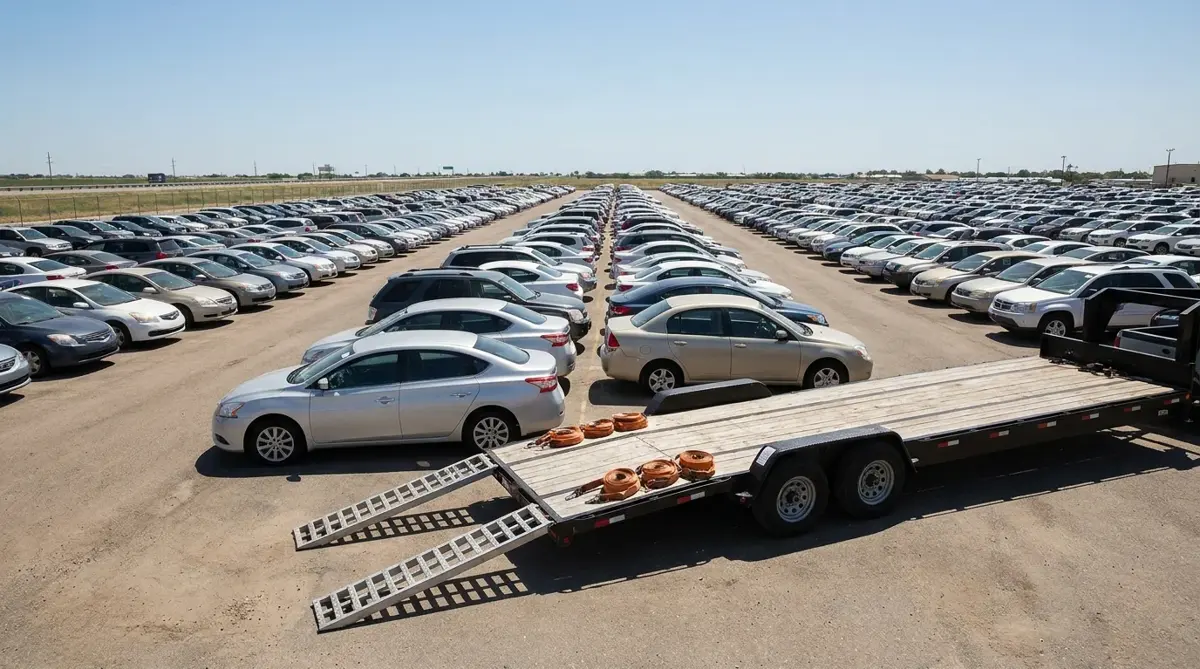
There's a wave moving through the used-car market right now, and if you know how to ride it, it's the best buying opportunity in years. Vehicle repossessions are running at their highest pace since the 2009-2010 era -- millions of cars a year going back to lenders as loans written at peak prices meet real-world budgets. Nobody celebrates a repo; it's a rough moment for the family involved. But every one of those vehicles ends up somewhere, and where they end up is the auction block. We've been helping buyers get auction cars home since 1999, and we can tell you the volume coming through those lanes right now is something we haven't seen in a long time.
Here's why that matters to a buyer: repo inventory doesn't distribute itself evenly. It piles up wherever the lenders and remarketing companies run their sales -- the big auction hubs in Texas, the Southeast, the Midwest, California's Central Valley. The specific truck you want at the price you want might cross the block in Dallas while you're sitting in Denver. Online bidding at Copart, IAA, Manheim, and the dealer platforms has made the whole country your used-car lot. The catch is the part the bidding platforms don't handle: the car is 900 miles away, and it's your job to come get it.
| Step | What happens | Watch out for |
|---|---|---|
| 1. Before you bid | Get transport bids for the route so shipping is priced into your max bid | Assuming shipping 'later' will be cheap or instant |
| 2. You win | Pay the auction, get the buyer number / stock number and receipt | Free storage clock starts -- often only 2-5 business days |
| 3. Book the carrier | Request your estimate; carriers already running auction lanes make their offers | Non-runner? Say so up front -- it needs a winch truck |
| 4. Gate release | You authorize the carrier with the auction; driver checks in with your buyer/lot number | Wrong or missing release = driver turned away, fees keep running |
| 5. Pickup & delivery | Condition report at the gate, transport, inspect at delivery | Document the car's condition -- auction units sell as-is |
That's a solvable problem, but it has a timer on it. Auction yards and repo lots are in the business of turning inventory, not storing your purchase. Most give you a short free window after the sale -- often just two to five business days -- and then daily storage starts, commonly $25 to $75 a day depending on the yard. Do the math on a week of dithering and you've handed back $200-$500 of the discount that made the auction worth it. The buyers who do this well have transport bids in hand before they bid on the car, so the truck is booked the same day the hammer falls.
“The auction discount has a timer on it -- every day a won car sits on the lot, storage fees are giving the deal back.”
Picking up from an auction is a little different from a driveway pickup, and it helps to know the dance. The carrier doesn't just show up -- they check in at the gate with your buyer number or lot/stock number and a gate release you've authorized through the auction. Get that paperwork lined up as soon as you pay, because a driver turned away at the gate is a wasted trip and the storage meter keeps running. And be straight about the car's condition: plenty of repo and salvage units don't start, and a non-runner needs a winch-equipped carrier, which typically adds $100 to $200. Surprising the driver with a dead vehicle at the gate is how pickups fall apart.
Ready to ship? Get a real price in 60 seconds.
We put your shipment in front of licensed auto transport companies running your route this week, and they send you their best offers — no obligation, no spam.
Get My Free Quote →What does the transport itself cost? The same as any comparable move: figure $400 to $700 for a regional haul and $1,000 to $1,400 coast to coast for a running vehicle on open transport. Here's the part that makes the whole strategy work -- auction lanes are some of the best-served routes in the country right now. Carriers run the big auction hubs constantly because the repo wave keeps them full, and a busy lane means competing offers. We regularly see auction pickups priced better per mile than ordinary residential moves simply because the trucks are already there.
A word on condition, because auction cars sell as-is: document everything. The carrier will do a condition report at the gate, but auction yards are busy places and the car may have sat outside for weeks. Pull the listing photos, keep them, and have the driver note anything visible at pickup on the bill of lading. At delivery, walk the car before you sign. This is standard practice for any shipment, but with an as-is purchase the paper trail matters more -- it's how you know what happened where.
Step back and the picture is bigger than repos. Tariffs have pushed new-car prices up, which pushes buyers to used, which makes the well-priced used car a national commodity -- bid on from three time zones away and shipped home. The repo wave is pouring inventory into exactly that market. For a buyer with patience and a transport plan, it adds up to the strongest out-of-state buying opportunity since the financial crisis, and this time the logistics are a solved problem.
That last part is where we come in. Tell us the route, and vetted, licensed carriers who already run those auction lanes compete to haul your car. Price the shipping before you bid, book it the day you win, and the deal you fought for at the auction stays a deal. Get your free estimate or call us at (800) 930-7417 -- and go get the car nobody in your zip code knows is for sale.
About the Author
American Auto Shipping
Dave Armstrong is one of American Auto Shipping's longest-tenured team members. As content manager and strategist, most of what you read on this website came from him. He has extensive knowledge of the auto transport industry, having spent time in every role the business has to offer.