





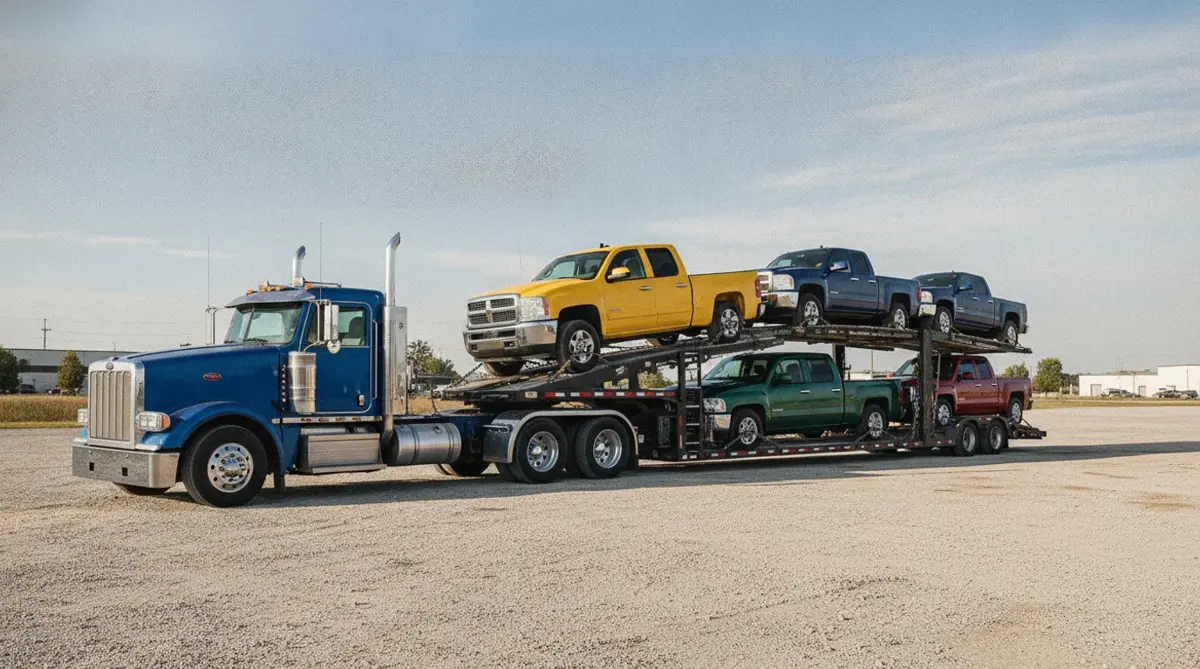
Pickup Truck Shipping
Half-ton, heavy-duty and midsize pickups: what changes on a car carrier, what it costs, and notes on every truck we cover.
A pickup truck ships on the same open car carriers as any other vehicle, with two differences. It takes more deck length and weight allowance than a sedan, so it is priced a step higher, and anything that adds height or width (a lift, tall tires, a rack, a camper shell or dual rear wheels) narrows which trailers can take it. A stock half-ton or midsize pickup is routine; a lifted truck or a dually may need a specific spot on the trailer or a different trailer altogether.
Jump to: cost table · models by brand · questions
What makes a pickup different to ship
Length. A full-size crew cab with a standard bed is around 20 feet long, and a long bed adds more. A car carrier has a fixed amount of deck, so two long trucks can take the space of three cars. Regular cabs and midsize trucks are much easier to place.
Weight. A half-ton pickup usually weighs somewhere around 4,000 to 5,500 pounds; three-quarter-ton and one-ton trucks, especially diesels, commonly run well past 6,000. A loaded car carrier must stay under the 80,000-pound federal gross weight limit on the Interstate, so heavy trucks use up that allowance faster. In our published formula a pickup is priced about 25% above a sedan.
Height and width. Most stock trucks fit any open carrier. Lift kits, oversized tires, ladder racks, toolboxes that rise above the bed rails, light bars and camper shells add height, and dual-rear-wheel trucks are wider at the back. Those are usually priced as oversize (about 50% above a sedan in our formula) and may need a lower deck position, a step-deck or a flatbed.
Open or enclosed. Open transport is the normal choice for work trucks and daily drivers. Enclosed (about 50% more in our formula) makes sense for a restored classic truck or a high-value limited edition. A truck that does not run needs a winch to load, which adds about 20%.
Getting a pickup ready
Most of this is the same as for any car (see the preparation guide); these are the truck-specific parts.
- Empty the bed and the cab. Loose items can shift or blow out of a bed, and a carrier's cargo insurance covers the vehicle, not what is in it.
- Secure or remove a soft tonneau cover, and take off anything that can flap or fall: bike racks, loose ratchet straps, removable light bars.
- Remove a fifth-wheel or gooseneck hitch if you can, and pull the receiver hitch and ball mount so they do not catch on the ramps.
- Measure the truck with its accessories on, and give the height, the lift and the tire size when you ask for an estimate.
- Fold or retract tow mirrors so the truck fits between the trailer uprights.
What it costs to ship pickup trucks
Ranges from our published estimate formula for this vehicle class, using this week's diesel price and this month's season. Distance moves the price far more than the model does.
| Distance | Pickup trucks, open | Pickup trucks, enclosed | Lifted truck or dually (oversize), open |
|---|---|---|---|
| 500 mi | $890 – $1,200 | $1,330 – $1,800 | $1,070 – $1,440 |
| 1,000 mi | $1,210 – $1,640 | $1,820 – $2,460 | $1,460 – $1,970 |
| 1,500 mi | $1,420 – $1,920 | $2,130 – $2,890 | $1,710 – $2,310 |
| 2,500 mi | $1,810 – $2,440 | $2,710 – $3,670 | $2,170 – $2,930 |
Stock pickups use the pickup class; lifted trucks and dual-rear-wheel trucks are usually priced as oversize. Metro pickup and delivery, a running vehicle, no strong north-south direction. For your own route, see the shipping cost estimator.
Formula v2026.09.2 · EIA U.S. diesel $6.35/gal, week of Oct 26, 2026, 52-week average $4.88 · October pricing · road distance as stated.
Estimate, not a quote. Produced automatically by our published formula from public data; your price comes from the licensed auto transport partner you choose. How we estimate · Get your free estimate
Fuel: U.S. Energy Information Administration. Routing: © OpenStreetMap contributors (OSRM). ZIP locations: U.S. Census Bureau.
Pickup trucks by brand
Every pickup we cover, with what matters when it ships. Older trucks are listed with their production years, because many people ship them after buying used. Each model opens to show its notes.
Models people request quotes for most
The pickup trucks people asked us for estimates on most often in the last two years, from our own estimate requests. It shows what people asked about, not what was shipped.
Chevrolet
Chevrolet Colorado
Since 2004 (not sold 2013–2014)
Chevrolet's midsize pickup. The first generation (2004–2012) came as a regular, extended or crew cab, the second (2015–2022) as an extended or crew cab, and the current one (since 2023) as a crew cab only. Midsize trucks take noticeably less deck than full-size ones; off-road versions such as the ZR2 sit higher on bigger tires, so give the trim.
Chevrolet Silverado 1500
Since 1999
Chevrolet's half-ton pickup, offered as a regular cab, an extended cab (called the Double Cab from 2014) and a crew cab, with short, standard and long beds. A regular cab is the easiest full-size truck to place on a carrier; a crew cab with the 8-foot bed is one of the longest half-tons, so give the cab and bed when you ask for an estimate.
Chevrolet Silverado 2500HD
Current
The three-quarter-ton Silverado, in regular, double and crew cab. It is heavier than a 1500 with the same cab, and the Duramax diesel adds weight over the front axle. A crew-cab long-bed HD is one of the longest trucks that rides on a standard car carrier: it usually fits, but it limits what else goes on that load.
Chevrolet Silverado 3500HD
Current
The one-ton Silverado comes with single or dual rear wheels. A single-rear-wheel 3500HD ships like a 2500HD; a dually is wider across the rear fenders and is often priced as oversize or moved on a flatbed.
Ford
Ford F-150
Current
The F-Series has been America's best-selling pickup line for decades. The F-150 comes as a Regular Cab, SuperCab or SuperCrew with 5.5-, 6.5- or 8-foot beds, and has had an aluminum-alloy body since the 2015 model year, so it is lighter than its size suggests. The electric F-150 Lightning is heavier; tell the company if yours is one.
Ford Maverick
2022–present
A compact pickup on a car-based platform, much shorter and lighter than an F-150 and easy to place on any carrier.
Ford Super Duty (F-250, F-350, F-450)
Current
Ford's heavy-duty pickups. Power Stroke diesels are heavy, crew cabs with 8-foot beds are long, and the F-350 dually and F-450 are wide at the back, so those are often priced as oversize. Say which one you have and whether it has a gooseneck or fifth-wheel hitch.
GMC
GMC Canyon
Current
GMC's midsize pickup, the Colorado's twin. The AT4X sits higher on larger tires.
GMC Sierra 1500
Current
The GMC twin of the Silverado 1500, same cabs, beds and transport needs. AT4 off-road versions come lifted from the factory; give the trim.
GMC Sierra 2500HD and 3500HD
Current
Heavy-duty Sierras, often diesel. A 3500HD dually is usually priced as oversize.
Jeep
Jeep Gladiator
2020–present
A midsize pickup based on the Wrangler, with a removable top and doors. Put the doors and top back on or stow them securely, and mention any lift or oversized tires.
Nissan
Nissan Frontier
Current
Nissan's midsize pickup, sold in the U.S. since the late 1990s and redesigned for 2022. King Cab and Crew Cab versions both ship as standard pickups.
Ram
Ram 1500 (and older Dodge Ram 1500)
Current
Ram became its own brand, split from Dodge, in 2010, so older trucks are titled as Dodge Ram. The half-ton ships like any full-size pickup; empty the RamBox bed storage along with the rest of the bed.
Ram 2500 and 3500
Current
Heavy-duty Rams, commonly with the Cummins diesel. Long crew cabs and 3500 duallys are among the trucks most often priced as oversize.
Toyota
Toyota Tacoma
1995–present
A long-time best seller among midsize pickups, redesigned for 2024. Off-road trims and lifted Tacomas sit higher; give the trim and any lift.
Toyota Tundra
2000–present
Toyota's full-size pickup, redesigned for 2022. A CrewMax with the longer bed is a long truck; it ships as a standard full-size pickup.
No models in this list match.
More pickup trucks by brand
Chevrolet
Chevrolet Avalanche
2002–2013
A crew-cab pickup built off the Suburban, with a short bed and a fold-down "midgate" between cab and bed. About the length of a large SUV; priced like a full-size pickup.
Chevrolet Silverado Hybrid
2004–2007, 2009–2013
GM sold a mild-hybrid Silverado in the mid-2000s and a two-mode hybrid from 2009 to 2013. It ships exactly like a gas Silverado 1500; make sure the regular 12-volt battery is charged so it can be driven on and off the trailer.
Ford
Ford Ranger
1983–2011, 2019–present
The original Ranger was a compact pickup; it returned to the U.S. as a midsize truck for 2019 and was redesigned for 2024. Older Rangers are among the smallest pickups on the road.
Nissan
Nissan Titan
2004–2024
Nissan's full-size pickup ended production after the 2024 model year. The heavier-duty Titan XD has a longer wheelbase and, on many trucks, a diesel engine; say which one you have.
No models in this list match.
Pickup trucks: common questions
Distance sets most of the price. In our published formula a stock pickup costs about 25% more than a sedan on the same route, and a lifted truck or dually about about 50% more. The table on this page shows current estimate ranges by distance; the licensed companies that make offers set the actual price.
Often, yes, but not in every position on the trailer. A lift and tall tires can make a truck too tall for the upper deck, so it goes on a lower spot, a step-deck or a flatbed. Give the overall height with the lift and accessories when you request your estimate so the offers come from companies that can load it.
Plan on an empty bed. Loose items can shift or blow out in transit, they add weight, and the carrier's cargo insurance covers the truck, not personal property. A bolted-down toolbox is fine; empty it first.
Usually. A dual-rear-wheel truck is wider across the rear fenders and heavier, so many companies treat it as oversize and some load it on a flatbed. Our formula prices oversize vehicles about about 50% above a sedan.
Open is the standard for heavy-duty trucks and costs much less. Enclosed trailers have their own weight limits and fewer of them can take a long, heavy crew-cab diesel, so ask for enclosed only when the truck's value justifies it.
Sources
- American Auto Shipping estimate requests, last 24 months (which models people ask about most; counts are not published)
- Federal Highway Administration: federal size and weight limits for trucks on the Interstate (80,000 lb gross vehicle weight)
- American Auto Shipping: How we estimate (vehicle class, oversize, enclosed and inoperable factors)
- Manufacturer model histories for the production years listed (Chevrolet, Ford, Nissan, Ram, Toyota, Hyundai)