





★ Key Takeaways
- ✓The shortage is drivers, not equipment. Yards are full of trailers nobody is licensed or willing to run.
- ✓Car hauling is hit harder than dry van: loading eight to nine vehicles on a multi-level trailer is a skill that takes months to build, so the pool of qualified drivers is much smaller.
- ✓Fewer drivers means fewer trucks available on your route, and thin capacity is what pushes a price up -- not fuel, most of the time.
- ✓Flexible pickup dates are worth more than they used to be. A three-day window can be the difference between four bids and one.
- ✓Rural and secondary routes feel it first, because drivers concentrate on the lanes that pay best per mile.
We have been in this business since 1999, and the thing people still get wrong about capacity is that they picture trucks. They imagine a yard somewhere with not enough trailers in it. That is not the shortage. The trailers are there. What is missing is people willing and qualified to drive them.
The American Trucking Associations projects the industry-wide driver gap widens to roughly 82,000 in 2026. That number gets quoted a lot in freight circles and mostly shrugged at by everyone else, because it sounds like somebody else's problem. It is not. It is the single biggest input into what you pay to move a car this year.
| Situation | Typical effect on bids | What helps |
|---|---|---|
| Major metro to major metro | Healthy capacity, little change | Nothing needed |
| Metro to rural | Fewer carriers, slower pickup | Widen the pickup window |
| Rural to rural | Thin capacity, higher price | Meet the truck at a nearby metro |
| Peak season on a popular lane | Bids fill fast, then dry up | Book four to six weeks ahead |
| Last-minute, fixed date | Fewest options, highest price | Pay for speed or move the date |
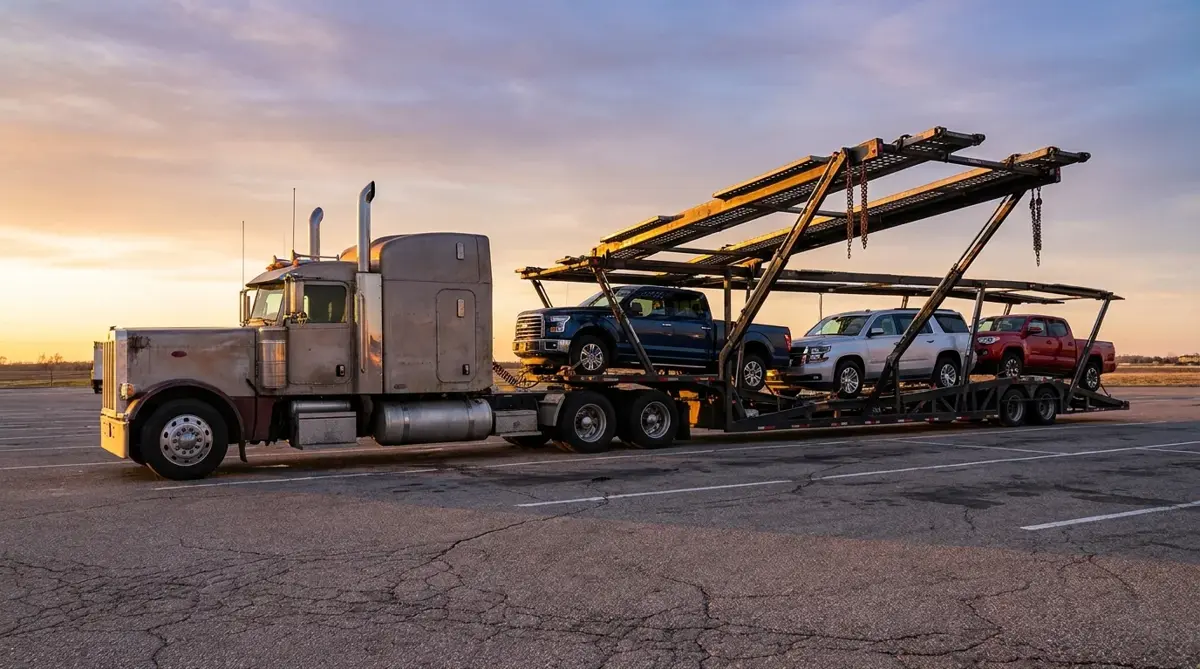
Car hauling feels it worse than the rest of freight, and the reason is specific. Anybody with a CDL can pull a dry van. Loading eight or nine vehicles onto a multi-level trailer -- getting the weight distribution right, working the hydraulics, threading a low-clearance sports car onto a top deck without touching anything -- is a genuinely difficult skill that takes months to build. When a car hauler leaves the industry, you cannot backfill them from the general driver pool next week. You have to grow one.
“A trailer with nobody licensed to drive it is not capacity. It is a parked asset.”
So when the general shortage widens, ours widens further, and it shows up in a way most customers never connect to the cause. You request a quote. Three companies offer instead of eight. The offers come in higher than the same route did in the spring. Everyone assumes fuel. Usually it is not fuel. It is that the lane you want has fewer trucks running it, and the ones that are running it can be choosier about what they take.
Ready to ship? Get a real price in 60 seconds.
We put your shipment in front of licensed auto transport companies running your route this week, and they send you their best offers — no obligation, no spam.
Get My Free Quote →This is where an agent earns its keep, and we would say that even if it were not what we do. When you call one company and take their number, you are seeing one carrier's view of your route on one day. When your shipment is posted where thousands of carriers can see it, you are seeing the whole market. In a tight-capacity year the spread between the best and worst bid on the same car widens considerably, and the only way to benefit from that spread is to actually see it.
The practical advice has shifted this year, and it is worth saying plainly. Flexibility has become the highest-value thing you can offer. A rigid pickup date -- has to be Tuesday, has to be Tuesday morning -- was a mild inconvenience three years ago. Now it can cut the number of willing carriers by half. A three-day window instead of a single date routinely brings in more carriers, and more carriers competing is what moves the price.
Distance from a major corridor matters more than it used to as well. Drivers concentrate on lanes that pay best per mile, which means interstate-adjacent metros are well served and everywhere else is progressively less so. If you are shipping from somewhere genuinely rural, meeting the truck at a shopping centre off the nearest interstate can save more than any discount code ever will. It is not glamorous advice. It works.
The one thing we would push back on is panic. A capacity shortage is not a crisis for the person shipping one car. It is a reason to book earlier and stay flexible, nothing more. The vehicles are still moving, roughly on schedule, at prices that have not changed dramatically for anyone who plans ahead. The people getting hurt are the ones calling on a Thursday for a Friday pickup on a route nobody runs.
If you want to see what your specific route looks like right now rather than in the abstract, get a quote and watch what comes back. The number of companies willing to offer tells you more about your lane than any industry statistic we could put in an article.
About the Author
American Auto Shipping
Dave Armstrong is one of American Auto Shipping's longest-tenured team members. As content manager and strategist, most of what you read on this website came from him. He has extensive knowledge of the auto transport industry, having spent time in every role the business has to offer.